
Black Mold Removal Salt Lake City, UT
Talk us through the growth and what got wet around it. We work from your independent assessor's report, size the containment to the extent it names, and take the material out sealed.
Is that black mold? Nobody names a mold by looking at it, and that includes us. Dark growth on wet material comes out the same way whatever its name turns out to be.
The longer that material stays wet, the more of your wall goes into the disposal bags with it. Hand us the protocol you already hold and we work the removal straight off it.
Call (801) 903-2904 and describe the growth on the wall and what got wet underneath it. Somebody answers this line whatever the hour.
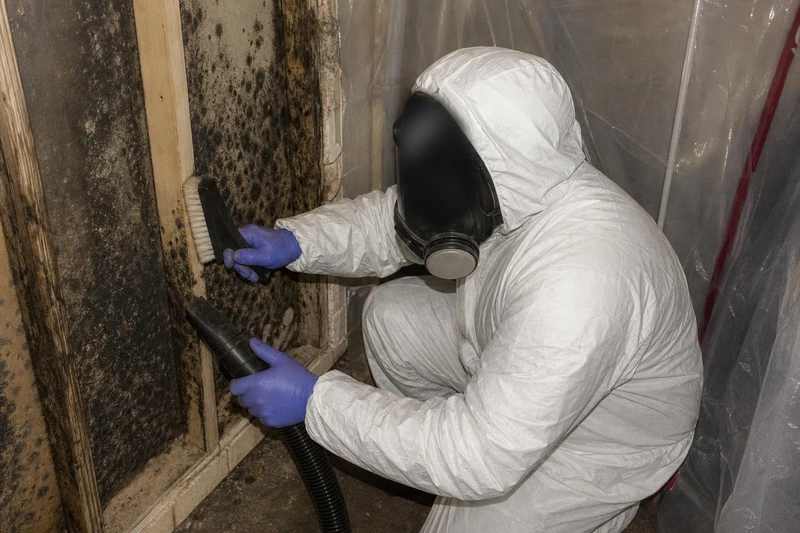
How Does Black Mold Removal Actually Work?
Controlled removal is the whole method, and no antimicrobial we spray can substitute for it. Everything we open goes out through one sealed exit, with the negative air still pulling behind it.
Porous material that grew something leaves the house for good. Framing and non-porous surfaces stay where they are, and we clean those in place instead.
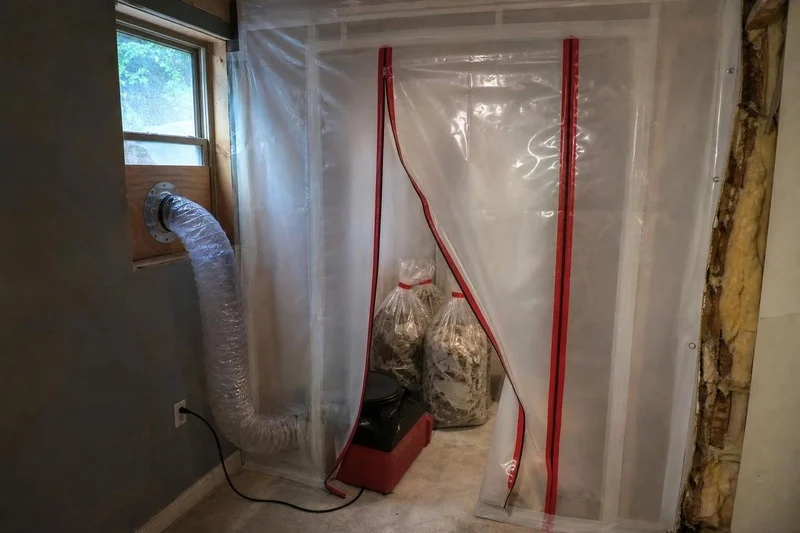
Before anyone cuts, we seal the containment area off from the rest of the building. We staple sheeting over every opening, tape the supply and return vents shut, and leave one controlled way in and out.
On a bigger job we build a step-through chamber instead of a single sealed flap. Nobody then walks straight out of the containment into a clean hallway.
The Sheeting Should Pull Inward the Whole Time
Then we run a filtered negative air machine and duct its exhaust outside the containment. The pressure differential does the holding, and the sheeting only gives that differential a shape.
You can check that yourself from the hallway, because the sheeting should suck inward on every surface. If it puffs outward at you, we have lost containment, and we fix that before another cut goes in.
Once the air moves the right way, the affected material comes out of the wall. We cut wallboard back past the growth line and bag it inside the containment, so nothing crosses the exit unsealed.
The exhaust runs outside the sheeting for as long as anything is open, because the moment that air has nowhere to go the containment stops working. Once the material is gone, we HEPA vacuum and damp wipe everything remaining, including the settled dust just outside the containment.
We apply antimicrobial to the cleaned surfaces last, and never first. It cannot reach what sits underneath the paper facing of a board that is still wet.
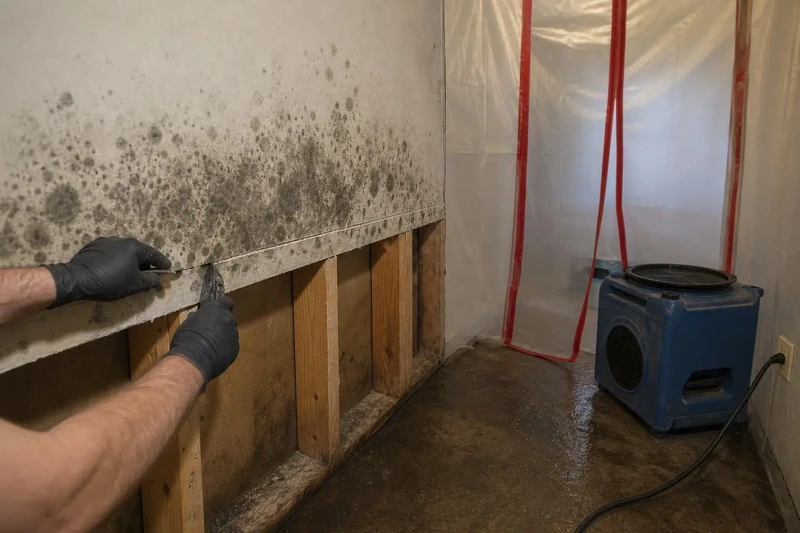
We Size Containment to the Extent, Never to the Patch You Can See
The patch on the surface is the smallest number in your job. Growth follows the water, and water goes into places you cannot see from the room. It runs into the wall cavity, under the cabinet kick, and onto the back of the drywall paper.
So we build containment around the extent your remediation protocol gives us, and never around what shows from the doorway.
Sizing to the extent instead of the patch changes three things.
- We staple the sheeting well wide of the stain, so no cut we make lands on the edge of the plastic.
- We size the negative air to the whole area your protocol names, not to the corner of it that shows.
- We build the containment once, because the extent behind the wall is already on paper before we start.
That decision saves you a day, because if we size the sheeting to the visible patch we strip it out and start over.
The moment we cut and meet growth running past the sheeting line, everything inside the containment is suspect. So is the room on the far side of it. We would rather ask you two more questions on the phone than build containment twice.
It changes what we ask you, too, because we want to know how far the wet area ran. The size of the dark mark tells us much less than that does.
A dinner-plate stain can sit on a wall that took a week of slow water behind it. That is a bigger job than a black streak on board that soaked once and dried the same day.
The Species Question Is the Wrong Question
The CDC guidance on mold is blunt about this. You do not need to know what type of mold you have, because the remediation is identical either way. That remediation is removal.
See it or smell it, and it comes out of the building. Our whole job runs on that one sentence, and it is why we never sell you a species name.
The mold people mean by black mold is greenish-black, and it feeds on paper-faced drywall, cardboard and framing. It needs constant moisture to keep going, and it is neither the only dark mold indoors nor the most common one.
Nobody reads a species off a color. We do not test, a photograph settles nothing, and the removal would not change if we did.
That cuts both ways, and this is the half we will not stretch for anybody. We work on buildings, and we do not work on people.
If somebody in the building feels unwell, that question belongs to a physician and never to us. Finishing a remediation here is never a verdict about anybody's health.
About the building itself we will be plain, because dried-out growth that looks dead is not finished. It still comes out of the wall.
No Mold Removal Spray Reaches the Back of the Board
Bleach and store-bought mold removal spray both work on a hard surface you can actually reach. Neither one reaches the back of a paper-faced board inside a wall.
Spray a stain and the color goes, while the material underneath stays exactly as wet as it was. Killing growth is not the same as removing it.
The last black mold question we get is whether it goes away for good. Growth returns to the same wall if the water returns, so that answer sits with the moisture.
Dry outside air does nothing for a wall cavity that is already wet inside. Sealed board and packed insulation hold that water where no breeze from the valley ever reaches it.
The Report Sets the Extent, and the Extent Sets the Job
A black mold job starts on a document we did not write. We do not test, inspect, or assess mold. An independent assessor does that, and we remediate to what their protocol says.
The first thing we read in that protocol is extent. Not the color, not the species, and not the size of the stain in the photograph somebody sent us.
Extent is what sizes the containment, the negative air and how much wall comes out. A protocol putting growth three stud bays past the visible edge is a different job from one that stops at the edge, even though both walls look identical from the doorway.
No report yet? Call anyway and we will tell you what a protocol normally spells out, so you know what you are reading when it lands. Call (801) 903-2904.
How Much Wall Leaves Decides What Black Mold Remediation Costs
The dark patch does not set the size of your job. What does set it never shows up in a photograph. That is why we price the work after somebody stands in the room with your remediation protocol.
- Your protocol lists how much material has to come out, and that number leads everything else.
- Growth that stayed on the surface costs less to remove than growth that ran into the cavity behind the board.
- The number of rooms inside the containment sets how much sheeting and how many air machines we bring.
- A step-through chamber takes longer to build than one sealed flap, and a bigger job usually needs one.
- Water that is still arriving keeps the material wet, so we cannot close the wall until it stops.
That last one is yours, and it is the cheapest move available to you. Close the shutoff, or the valve behind whatever let go, and stop the water before we arrive.
Sheeting around material that is still getting wet means we come back and open the same wall twice. Where the water arrives from outside the building instead, a grading or drainage contractor owns that end.
We bring the same plastic and the same machines to a Yalecrest bungalow on 84108. We run the identical sequence at a house near Emigration Creek, because the address does not change the work.
For the public-health side of it, the Salt Lake County Health Department covers Salt Lake City along with the rest of the county.
You Bring the Report, We Bring the Plastic
We handle black mold removal in Salt Lake City the same way every time. Your report sets the extent, we size containment to it, and the material leaves the house sealed.
We HEPA clean and dry the cavity while it is still open to the room. The carpentry that follows then lands on sound, dry material rather than on a guess.
Most of these start as water somebody found too late, and we take that end on as well. That is water damage restoration work, and it reaches the same phone and the same crews.
If your problem is mold generally rather than a dark patch, our mold remediation page covers the wider version. We cross the city line for both, and our crews cover Millcreek the same way.
Call (801) 903-2904 and tell us what got wet and how long it stayed that way. Say whether a report is in your hand, because that is the first thing to sort out.
If the answer is no, say so, because sorting that out does not need us at all. Salt Lake City, day or night, somebody answers.
We Answer These Five Before Anyone Cuts Anything
These land on nearly every black mold call, and none of them replaces a look at your actual wall. Ask us the rest on (801) 903-2904.
Your carrier decides that, and it turns on the water rather than on the mold. Many policies treat mold as a consequence of a covered water event, so a supply line that failed last week reads very differently to an adjuster than a slow leak nobody found for months. What helps you either way is paper: your independent assessor's report establishes the extent, and our written scope records what came out, how we contained the area, and how we cleaned it. We document the job that way from the first day. We will not tell you it is covered, because that call is not ours to make.
The size of the job follows how much building has to come out, and five things drive that: the quantity of material your protocol lists, whether growth stayed on the surface or ran into the cavity behind the board, how many rooms fall inside the containment, whether that containment needs a step-through chamber or one sealed flap, and whether the moisture source is dry yet. We cannot read a single one of those off a photograph. A patch the size of a dinner plate on a wall that took a week of slow water is a bigger job than a dark streak across two feet of board that got soaked once. So the figure comes after somebody has stood in your room with the protocol, never before. Call and describe the wall, and we will tell you which of those five you are looking at.
We will not put a number on that, because no Utah prevalence figure sits in front of us and inventing one would be worse than saying so. What we can give you is the mechanism. Growth here follows one trapped water source rather than the weather, which is why dry outside air does nothing for a wall cavity that is already wet inside. A closed cavity keeps its own humidity, and the material in there does not care what the valley is doing. So the question that helps you is not how common black mold is in Utah, it is how long your wall stayed wet.
Some of it, yes. Surface growth on something hard and non-porous, tile or sealed metal for instance, is a cloth-and-bucket job, and public health guidance says as much. What you should not take on yourself is anything that means opening a wall. Cut into board with growth on the back of it and spores go into the air, and without sheeting and negative air you have moved a one-room problem into rooms that never had one. Growth on paper-faced drywall, behind a cabinet or inside a cavity is where you stop and get the report.
It gets expensive when the building has to come apart, not because the mold itself is exotic. The mildest version is surface growth on one wall, caught while the material behind it is still sound and the leak is already dry. The heaviest version is growth that traveled inside the cavities and crossed into two or three rooms, so containment has to cover all of them and we count the material coming out in walls. Price a job off the visible patch and we reprice it the day containment goes up and we meet the real extent, which is the reason we work from your report instead of a guess. Call and tell us how far the wet area ran, because that moves the job far more than the color of the stain does.
One Number Reaches the Whole Crew
The line rings through to a person at 3 a.m. exactly as it does at noon. Call Water Damage Restoration Salt Lake City and you hear an honest arrival time, not a script.
Do You Know How Far Behind That Wall It Runs?
Keep your assessor's protocol in front of you when you call (801) 903-2904. We size the sheeting and the negative air straight off the extent that document names.