
Commercial Water Damage Restoration Salt Lake City, UT
Which part of your space has to stay open while the rest of it drains? That answer sets the order we pull the water in, and a person takes this call whatever the hour.
We come out, pump the standing water off your floor, and pull the material that will not come back. Then we dry what is left, one zone at a time, so the rest of your space keeps working. Call (801) 903-2904 and we start it.
We will not close your whole floor plate to dry one wet corner of it. Shutting every door is the easy way to work, and the lost days cost you twice.
We will not start a machine before we have walked every wet room either. A partial extraction in an occupied building still has to leave a walkable path through it.
Get your people off the wet floor and away from anything electrical, then call us. If you can safely reach the shutoff for your own space, close it, and from there it is ours.
We will ask how much floor is wet, which part has to stay open, and who can unlock the rest. That is what we load the truck from before we roll out, and a person takes this call at any hour.
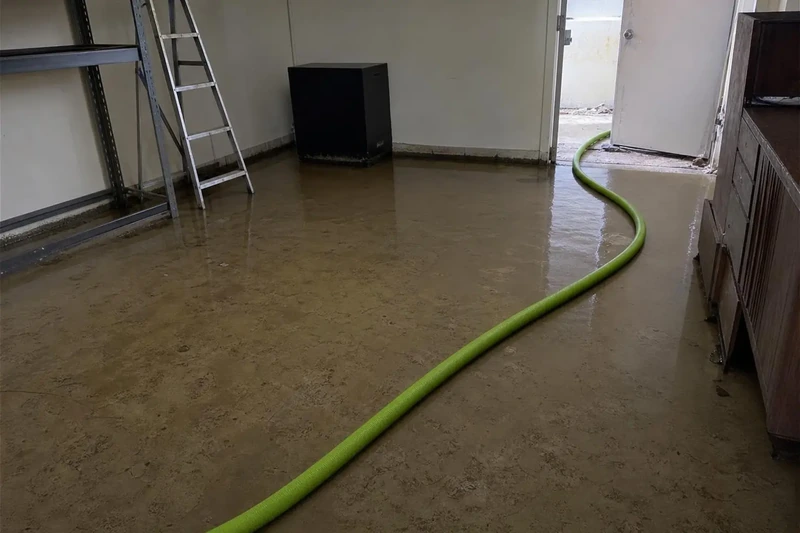
We Pump the Standing Water Out of One Commercial Zone at a Time
The walk comes first, and it tells us how far the water has already traveled and what it got under. It also tells us which doors somebody has to unlock before we can finish a zone.
What we read on that first pass
- Every wet room on the plate.
- What the water got under.
- Which doors stay locked.
- The level below the wet one.
- Floor type in each zone.
- Whatever is sitting on the floor.
Then we set the order and work one zone at a time, starting wherever we can get in. The wettest zone is often the one we reach last, because a stock room or a mechanical room needs a key we do not hold. So we work the open zones while somebody finds that key.
Then the water leaves on a machine
Our truck-mounted extractor parks at the loading door or the curb, and we run hose in along the walls. We tape it flat at the thresholds, so your aisles still work as aisles.
A submersible pump takes anything sitting deep, in a pit or on a below-grade level. On carpet and carpet tile we run a weighted wand slowly, in overlapping passes that lift the water out of the backing. On sealed concrete or quarry tile we squeegee the water into a pool and lift it with the wand.
We lift product and equipment off the floor before we pull the water out from under them. A pallet holds a film of water under its base long after the aisle looks dry. The carton on that pallet then wicks that film up into stock the water never reached.
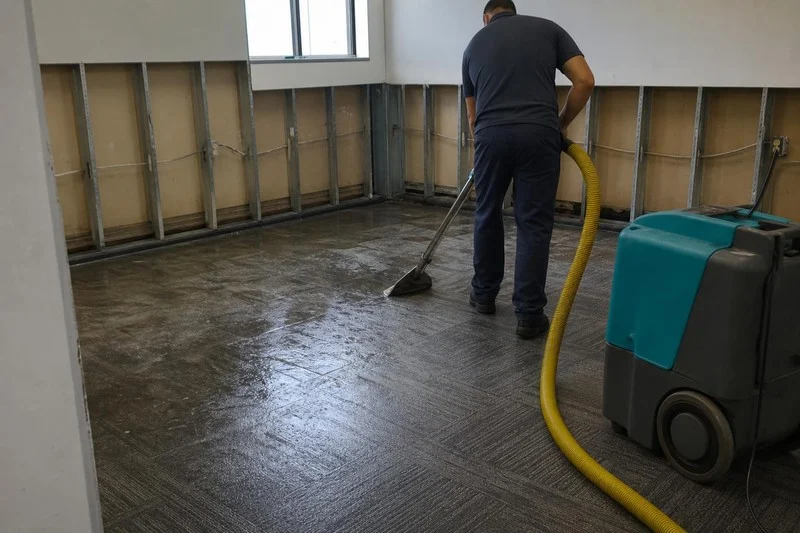
We Build the Job Around the Zone That Has to Stay Open
Tell us which doors have to keep working and we sequence the whole job around them. We close the wet zone off with poly sheeting on a frame and run an air scrubber inside it. The air pulls from your working side toward the wet side, so nothing drifts back the wrong way.
The wet part of your building is then the only part that stops. The machines go along walls and under counters, with the cords kept out of the walking lines. We leave a clear route from your entrance to whatever part of the space is still serving people.
If a machine is in your way, tell us and we will move it, because a machine somebody switches off dries nothing. Your reopening date comes from what we find on your floor, and you will hear it straight from us.
Tell Us Who Can Open Which Door
The most useful thing you can hand us is a list of who unlocks what in your building. On a commercial job, a locked room stalls us far longer than a big spill on an open floor.
The doors that stall a commercial job
- Suites and stock rooms.
- The mechanical room.
- The level below yours.
- The roof hatch.
Water on one level runs down through the penetrations in the slab and lands in the space below. So we check underneath before we call any zone finished, and we tell you what we found.
Some buildings only open to us outside business hours, and we can work then. Your access hours set the order we work in.
When we leave equipment running, we place it along the wall and well out of the walking lane, so anybody crossing that floor keeps a clear path.
Shut the Water Off Before We Get There
Close what you can safely reach, which is usually the isolation valve for your own space. The stop behind whatever fixture let go does the same job.
The building main may sit behind a door somebody else holds, so make that call now, before we arrive. A plumber fixes the failed line, and we handle the water that already came out of it.
Neither of us waits for the other, so put both of us in motion on the same round of calls.
Sometimes the water arrives from the service side, outside your walls. Then Salt Lake City Public Utilities handles the meter and the main feeding your building. Put that call in alongside ours, inside the first minute of finding the water.
Your Commercial Water Damage Bill Tracks Access, Not Depth
We walk your floor plate before anybody puts a price on it. We can still tell you what moves the number, because the same things drive every commercial job here.
Where your money actually goes
Wet floor area comes first, and we measure the area itself. A thin spread across a whole floor plate takes more machine time than a deep puddle in one restroom.
Hours come second, because everything porous drinks the whole time it waits for a machine. The gap between the failure and the first extractor running shows up directly in the price.
Reach comes third, meaning whether the water stayed on the surface or got into the wall cavities. Water under finished flooring and inside a stud bay costs the most to chase and dry.
The kind of water comes fourth, and contaminated water changes the whole sequence. We contain the zone, strip the porous material and clean it before we dry any of it.
One driver belongs to commercial buildings alone, and it is how much of the space we can reach in a single visit. A shift that has to finish, or a room we cannot enter yet, stretches the job without adding a drop of water.
Call (801) 903-2904 and say how much floor is wet and which zones have to keep working. We will load the truck for exactly that layout before we roll out.
We Pull the Moisture Out of Cavities, Subfloor and Slab
Once the standing water leaves your floor, whatever is left has to leave your building as vapor. The USGS water science school lays out how water moves between liquid and vapor.
Air movers strip the wet air off concrete and drywall, which keeps evaporation running. We pair them with dehumidifiers, which catch what the fans lift and empty it down a drain line. That is what stops your wet zone from slowly wetting the dry one beside it.
This stage is structural drying, and it runs longer than the extraction did. Salt Lake City sits at 4,223 feet, and a floor plate this size needs a bank of machines whatever the elevation.
We size that bank to the wet area rather than to the room count. More units means more amps, so we spread that load across circuits and tell you which panels we are on.
Inside the walls we take the baseboard off and drill a line of weep holes. Air reaches the wall cavity that way, and we leave the rest of the wall closed up.
Under finished flooring we lift a plank and read the subfloor. Some soaked material will not come back inside its drying window, so we flood cut it well clear of the water line and bag it on the spot.
We chase the rest with a moisture meter until the wall reads the same as dry material nearby. Then whoever puts the wall back can start.
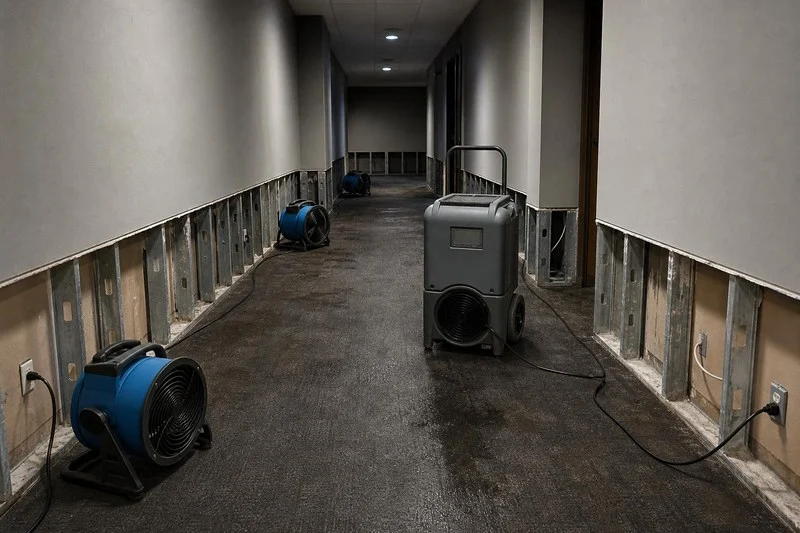
We Photograph and Log Everything Before It Leaves the Building
A commercial loss draws paperwork a house never does, so we photograph the wet areas while they are still wet. We mark what we cut and note exactly where the water line sat on every wall.
We write every reading into a drying log, day by day, from the first probe to the last one. That file is yours, and it goes to your insurer without you rebuilding any of it from memory.
Your insurer decides the claim, and what we hand them is the record of what the water reached. We photograph it while it is still there, because nobody can go back and take those pictures later.
We Cover Commercial Addresses From 84101 Out to the County Line
A Downtown address in 84101 gets the same rig as a warehouse on the edge of the valley. Central City storefronts and Ballpark district units get the same rig.
Your address only changes the drive, because we carry hose to wherever the water is.
If water is still coming in and nothing on your floor is dry, start with emergency water removal and call while you read it.
Our rotation covers the whole county, not just the addresses inside the city boundary. We run the same commercial work over in West Valley City and Murray, with the same crew and the same equipment list. For everything else this number covers, start at the main water damage restoration page.
We do commercial water damage restoration in Salt Lake City, and our trucks carry extraction gear sized for a whole floor plate. Call (801) 903-2904 and tell us which zone is wet and which one has to stay open.
Bring Us These Answers Before We Roll Out
These are the four questions we hear first on a commercial job. A real answer for your building still comes from one of us standing on your floor, so bring everything else to (801) 903-2904.
We price it on what we find standing in it, starting with the square footage that actually took water. The hours between the failure and the first machine running on it come next.
How far the water reached matters just as much, because surface water, wall cavities and finished flooring all price differently.
Two more things move a commercial number, and both of them are access questions. How much of the space we can reach in one visit, and what was sitting on the floor when it went. Nobody prices a building sight unseen, so we walk yours and then tell you.
Our method is the answer, and you can hold us to it. A person answers this number at any hour, and we walk your whole space before the first machine runs.
The extraction order then follows the doors that have to stay open, one zone at a time. We pull the standing water out mechanically first, on a truck-mounted unit and a submersible pump.
We photograph and log what was wet and what left the building, so you have paper for your insurer.
Weeks, and in a commercial building often much longer than that. A supply line above a ceiling grid or inside a chase has nothing to show for itself.
It stays quiet until the tile stains or the baseboard swells on that wall. A slab leak under fixed shelving can run for months, because nobody stands where they would feel it.
What usually gives it away first is a warm patch on the floor or a musty smell in one bay. Either one earns a call while it is still one bay and not the whole plate.
Extraction is the first visit, and the standing water leaves your building that same day. Drying then takes as long as the wettest material in your space needs.
We settle that by measuring the material, and the meter decides when we pull the machines. Two things stretch it on a commercial job, and both of them are about access.
How much of the space we can get into at once is the first, and how much soaked material stays in the building is the second. We hand you a working window after the walk, and if it moves we tell you out loud.
One Number Reaches the Whole Crew
The line rings through to a person at 3 a.m. exactly as it does at noon. Call Water Damage Restoration Salt Lake City and you hear an honest arrival time, not a script.
Start With the Zone That Cannot Close.
The wet zone is the only part of your building that has to stop. Call (801) 903-2904 and we sequence the rest of the floor plate around the doors you need open.