
Flooded Basement Cleanup Salt Lake City, UT
Is there water standing on your basement floor? Nothing down there drains it on its own, so we come with a pump for the depth and an extractor for the film the pump leaves behind.
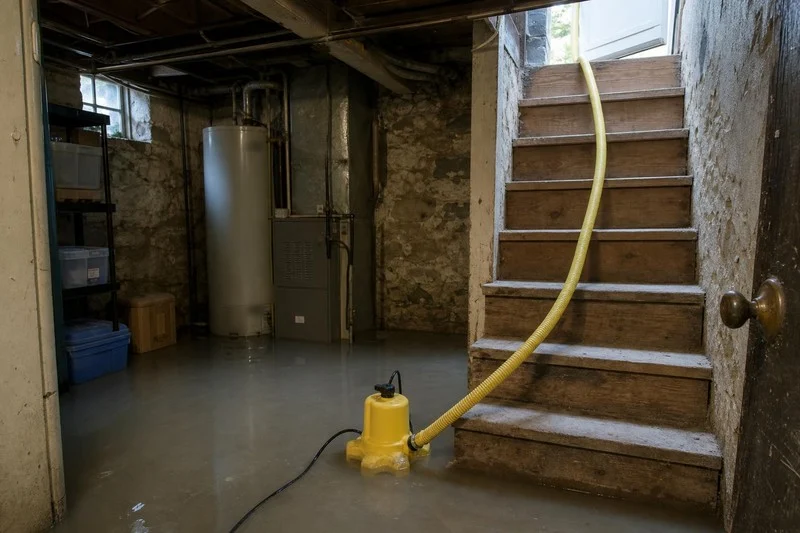
We position a submersible pump at the lowest point on your floor and remove the standing depth first. Then we switch to extraction equipment for the film a pump physically cannot lift. Call (801) 903-2904 and tell us how deep the water is right now.
A house up in The Avenues on 84103 and a newer place out on the valley floor hit the same wall. Water below grade has no low side to run to. It settles on the slab and saturates everything porous it can reach, and every hour of that trades drying for hauling.
We answer at any hour, and we arrive carrying both machines. Tell us the depth and whether the water is still rising, and we load the truck for that.
How We Pump a Basement Flood Down, Then Extract the Rest
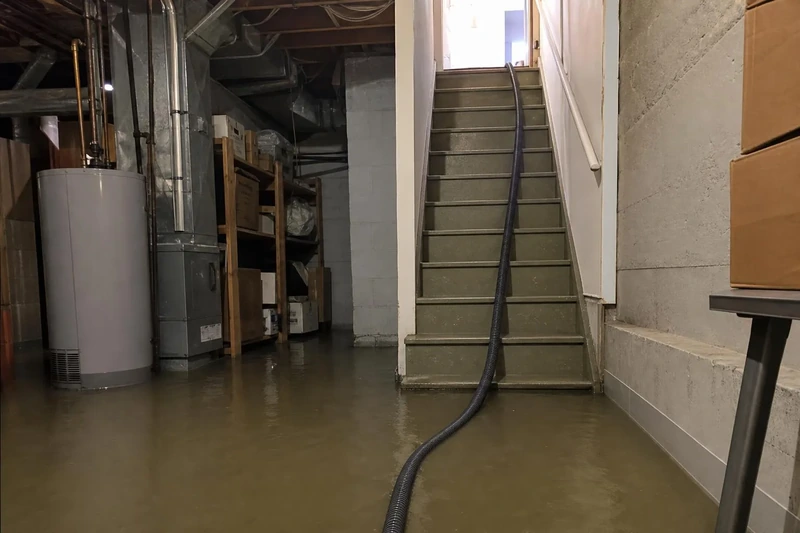
We set a submersible pump at the lowest point and send the standing depth outside. The discharge hose runs up the stairwell, away from the foundation wall the water came through. That is the fastest part of the visit.
The pump loses prime, and we switch machines
A pump moves a column of water, and it keeps moving until the intake starts pulling air. The moment it loses prime is the handoff, and we watch for it.
What the pump leaves behind is a shallow film across the entire slab, plus whatever has already crept under the baseboard. That last fraction of an inch is what keeps a basement damp for a week.
The extractor takes the last quarter inch
We position a weighted wand on a portable extraction unit and pull the remaining film out of the carpet. On a hard floor we squeegee the water toward the wand instead of chasing it with a mop.
Where carpet sat under water, we remove the carpet pad in strips through your door. A saturated pad is a sponge nobody dries in place, and the tack strip usually comes up with it.
We hold that order even when somebody wants the air movers running early. We do not begin drying while water is still arriving, because fans blowing across standing water buy you noise and nothing else.
Why the Water Comes Back After the Pump Runs Dry
Two completely different situations put water on a basement floor. A supply line that burst above you delivers a finite amount, and it stops the second somebody closes a valve. Saturated ground outside the foundation keeps delivering for as long as the ground stays saturated.
Wet soil presses on your foundation wall
Soaked soil packed against the foundation presses on that wall the entire way down. The pressure finds whatever openings the wall already has. A cold joint at the footing, an old form tie, a hairline that never leaked while the ground was dry.
None of that is a plumbing failure, and a bigger pump does not solve it either.
So we ask what the water is doing, not only how much is sitting there. Event water from a thaw or a passed storm will stop, and we handle it as one cleanup.
A wall that takes water every wet season is a drainage question for the contractor who does that work. Either way, the water standing there right now comes out the same two ways.
Cut the Power Before You Step Into It
Live outlets at ankle height are the part of this that genuinely hurts people. If the electrical panel is down there in the water, stay on the stairs and say so when you call.
- Shut the power off at the panel, as long as you can reach it without stepping into water.
- Close the main shutoff if the water is arriving from a supply line inside the house.
- Move cardboard, particle board and anything upholstered onto a dry stair tread.
- Call us with the depth, the room, and whether the water is clean or came up out of a drain.
That second step matters, because a pump fighting an open supply line only holds the depth steady.
Porous material pulls water up into itself inside the first hour. Getting it onto a dry tread immediately is what saves it.
If a sump pump quit and that is why the water is there, say so on the phone. The contractor who services the pit handles that end while we handle the water. Call (801) 903-2904.
Drying the Basement Water Damage Behind Your Walls
A dry-looking slab is not a dry basement. Water that had hours to travel now sits inside the bottom of the drywall and the wall cavity. It runs the tack strip line as well, and no air mover reaches it there.
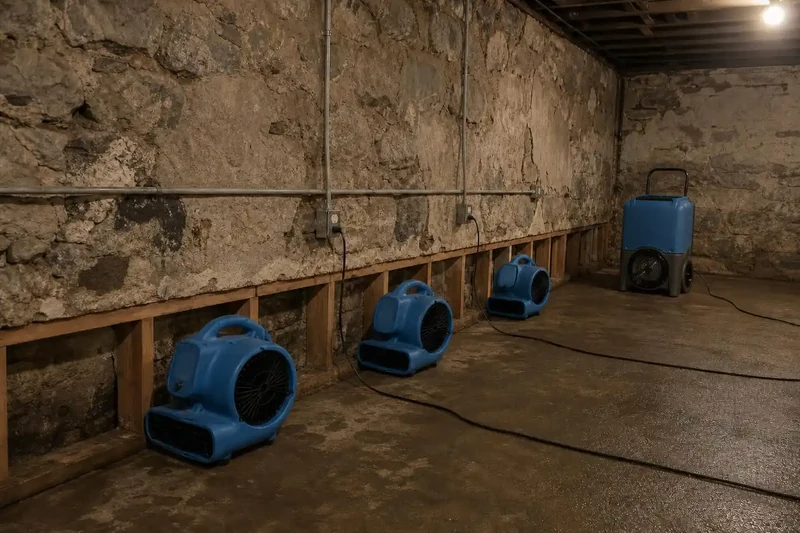
So we open whatever has to be opened. We remove the baseboard and drill weep holes so air circulates inside the stud bay. Where the drywall drank too much, we cut it straight across, above where the moisture reads.
We bag the insulation behind it and carry out everything that cannot be saved. Whatever can stay, stays.
Then we bring in air movers and position them low along the wall line. They pull the saturated skin of air off the surfaces, so the material keeps handing its water back.
Our dehumidifiers collect that water into a tank and carry it out of the building. The trade calls this stage structural drying, which means pulling water out of the material itself.
A moisture meter decides where the machines go next
We return while the equipment runs and put a moisture meter on the wall. A spot reading the same as material that never got wet has nothing left to give an air mover. That unit moves to a spot still registering high.
Call us if the equipment is too loud to live with and we will reposition it. Unplug one halfway through and the basement starts over.
Depth Is the Cheapest Number in Your Basement
Everybody asks about depth first, and depth is the one number that barely matters. Four other things set the size of the job. The first is how much floor area actually got wet. The second is how many hours passed between the water arriving and a pump reaching it.
The third is whether the water traveled under finished flooring and up into the wall cavities. The fourth is whether it was clean water, or water that picked something up on the way in.
So we will not name a number over the phone. A figure that lands low on a phone call becomes an argument on the final day.
What we want on the phone is the depth at the lowest point on your floor, and whether it is still rising or stopped the moment somebody closed a valve. We also want to know whether it is clean water or whether it came up out of a floor drain, because that one changes the whole order of the visit.
Say those and we will name the equipment we are loading before we pull out. Call (801) 903-2904.
Say Where You Are and We Load for That Drive
We run flooded basement cleanup across Salt Lake County, and where you are changes the drive rather than the method. City Creek is one of the named creeks inside the city limits.
A heavy runoff year in a drainage like that fills basements with water that never came out of a pipe. The supply line above your head is the other way in.
The federal flood program shows a single recorded loss in 84103 and paid out nothing on it. Most of the water we pump out of basements here was never a flood in the insurance sense. So what happened matters as much as how deep it got.
The National Weather Service office here publishes the runoff and storm picture for the valley. Utah's emergency management division covers what to do while water is still arriving from outside.
A basement in Millcreek and one in Holladay get the same two machines in the same order. If yours came up through a floor drain, that is sewage cleanup and the order changes.
Everything else that runs off this number sits on our main water damage restoration and drying page. Call (801) 903-2904 and say how deep the water in your basement is, anywhere in Salt Lake City.
Cost, Insurance, and Two Inches of Water
Every one of these has reached us from somebody standing at the top of their own basement stairs. Your basement still needs eyes on it, and (801) 903-2904 is how you get them.
Depth is the weakest predictor we have. Four things carry more weight: the saturated floor area, the hours before a pump reached it, how far the water traveled, and whether it was clean or contaminated. Tell us the room and the depth, and we will name the equipment before anyone names a figure.
How the water got in decides this, and your own policy is the only thing that settles it. A supply line letting go upstairs is a sudden internal failure, and water that soaked in through the ground is not. Standard homeowners policies treat those two perils very differently, so ask your agent. We document the loss as we work, so your adjuster is reading a record instead of a memory.
In this order: cut the power, stop the source, then pump the standing depth out. Next we extract the film a pump cannot lift, and carry out the carpet pad and anything porous. Then we dry the structure with air movers and dehumidifiers. Fans over standing water dry nothing, and closing a wall before the cavity dries turns into a mold job.
Two inches is enough to need a pump and not enough for a pump to finish the job. A submersible drops in at the lowest point and pulls the depth down until the intake starts taking air. What remains is a film the pump physically cannot lift, and it keeps the room wet. We remove it with an extraction wand, because a wet vac only handles a puddle.
Your building does, which is exactly the problem. Carpet pad, drywall, insulation, particle board and cardboard all wick water upward past the line it stood at. That is why drywall usually reads wet well above where the water actually was. Nothing sold in a bag absorbs a flooded basement, so we remove the water mechanically and carry the saturated material out.
A leak and an event are not the same thing to an insurer. Insurers commonly exclude water that seeps in gradually through a wall or a floor. A sudden failure inside the house is usually the one they do not exclude. We write down where the water reached and when we arrived, so that decision is made off a record.
Usually only when the policy carries the endorsement for it. Insurers commonly sell water backup and sump overflow as a separate rider. Whether somebody bought that rider was settled when the policy was written, not on the night the pump quit. A failed sump leaves the same water on the same slab, so the cleanup runs exactly the same way.
One Number Reaches the Whole Crew
The line rings through to a person at 3 a.m. exactly as it does at noon. Call Water Damage Restoration Salt Lake City and you hear an honest arrival time, not a script.
Tell Us the Depth and We Load the Right Pump
How deep is it, and is it still rising? Those two answers decide what goes on the truck, and we would rather hear them now than guess at your door. Somebody picks up at any hour.