
Water Damage Restoration West Valley City, UT
Did the wet edge stop where you can see it, or is a control joint still running water under the rest of that West Valley City floor? Call and we trace both ends before we scope it.
We get the standing water off your floor first, read where it traveled, then carry out the soaked material that will not come back. Drying gear follows. Call (801) 903-2904 and say which room it is in.
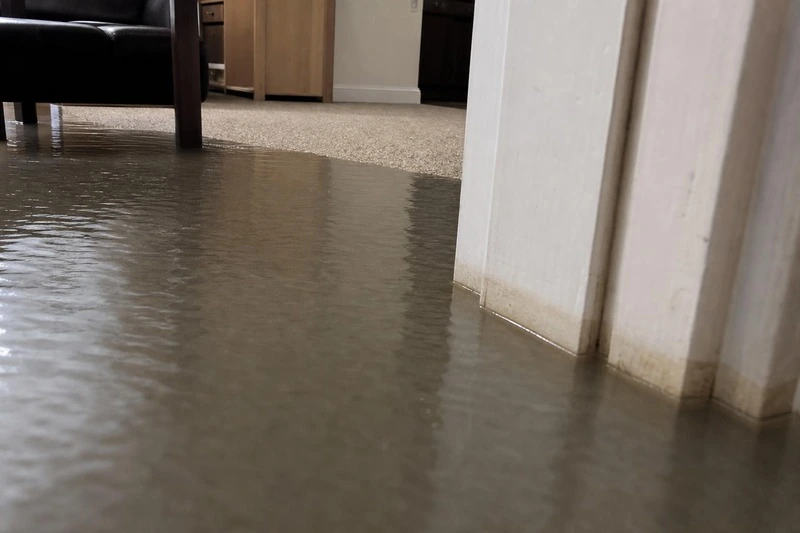
Standing water is already working into your house while it sits there. Carpet pad drinks it, baseboard swells, and the bottom of the drywall wicks it upward.
The cause barely changes that. A supply line, a melt event, a backed up drain: material soaks at the same speed once water is on the floor.
So the first job is volume. Every hour it stays down, the water reaches further into things we cut out instead of drying.
Extraction Along the Joint Lines, Not Just the Field
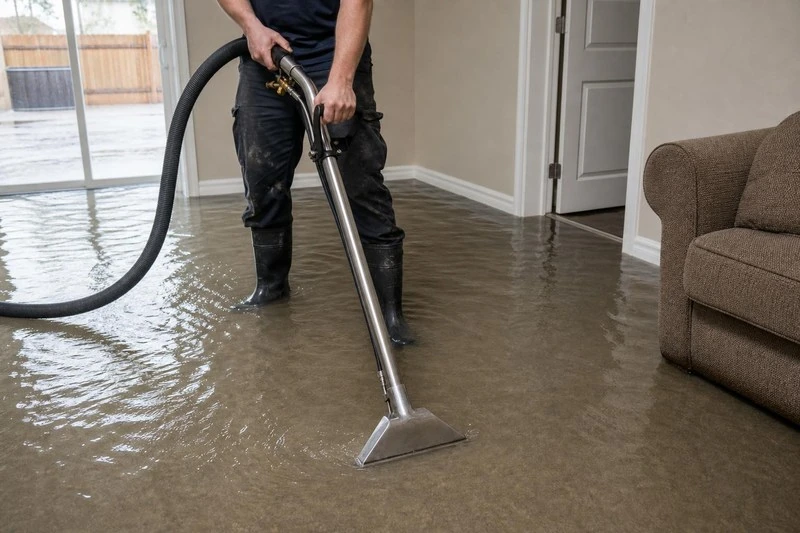
We take the water out before anything else happens. On a wide open floor that takes two passes, and the second pass is the one people skip.
A portable extractor pulls water out of the surface its wand is pressed against. That is the whole of its reach. It has no way to lift a volume sitting in a channel an inch below the wand and off to one side.
Builders pour big floor plates with control joints cut into them. Water finds a joint, drops in, and runs the length of it, well past the wet edge anybody can see.
Where the extractor's reach ends
Work the open field with the wand and the carpet gives up what the wand can reach. The joint keeps handing water back after the field pass looks finished.
That is a capacity problem, not a patience problem. The machine is doing everything it can do, and the water in the joint sits outside what it can do.
So we trace and read the joint runs before we scope the room. Where a run ends decides how much of your floor is really in this job.
How we work the joint runs
- We mark both ends of every run first, so the joint sets the size of the job, not the doorway.
- Deep water goes to a pump, a submersible where it pools and a trash pump where there is grit in it.
- The open field gets the portable extractor, worked in overlapping passes until the carpet stops giving anything back.
- Then we squeegee each joint line toward the wand, and we re-read both ends of every run before we call the extraction finished.
That last step is the point of the whole order. A joint still holding water will refill the pad above it overnight, and then we are drying a floor that keeps getting topped up from underneath.
Where the Water Came From in a West Valley City Home
Where the water started tells us which rooms to open, and in what order.
West Valley City holds 40,691 housing units, and 26,847 of them are single family detached homes. About 45 percent were finished before 1980, and the largest single group, 10,119 of them, went up across the 1970s.
Why the age of the stock matters here
A house that old is on its second or third water heater and often its first supply lines. Homes of that era carry swamp coolers over finished ceilings, and only 201 homes here were finished in 2020 or later.
Here is the whole set, grouped by where the water starts.
- Pressurized lines and tanks, meaning a burst or frozen pipe, a water heater failure, or a washing machine, dishwasher or appliance supply line.
- Drains and fixtures, which covers a toilet or fixture overflow and a sewer or drain backup coming up the lowest opening.
- The swamp cooler, an evaporative cooler that drips down a chase and stains a ceiling rooms from the unit.
- Water from above, meaning a roof leak, or an ice dam pushing melt back under the shingles.
- Water from outside and below, which is snowmelt and storm runoff loading the ground, or basement seepage and groundwater through a floor seam.
- The yard side, meaning a sprinkler or irrigation backflow, and a sump pump failure that lets the pit spill over.
Every one ends the same way for us. Water gets inside, the flow stops, and we take it out.
Snowmelt and runoff work differently, because the ground holds the water first and releases it later. The USGS Water Science School covers how surface water and groundwater move.
Drying a Wide Floor Plate and Its Joints
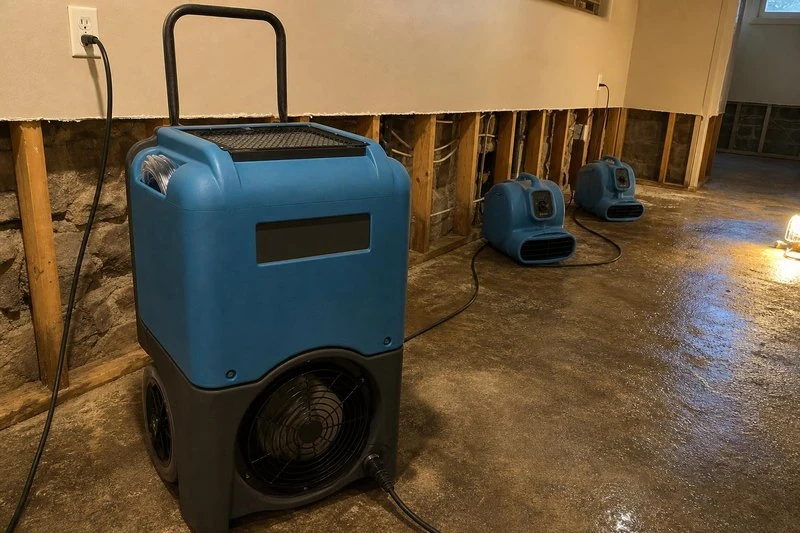
Once the standing water is gone, the wet material is the job. Air movers go low along the walls to lift moisture off the surfaces, and dehumidifiers pull it out of the air.
We set axial fans at the ends of the joint runs as well as across the open field. Those ends gave water up last, so they dry last.
Why a lower level on concrete takes longer
Concrete gives its water back slowly, and a finished lower level stacks carpet, pad and framing on top of it. So the gear stays down there longer than upstairs.
We check the same points we marked on the first day with a meter in hand. Once every marked point reads like a room the water skipped, the gear comes out.
What We Keep and What Goes Out the Door
Carpet often comes back. The pad under it almost never does, because it presses water against the slab and cannot be dried in place fast enough.
Drywall depends on how far the water wicked up the sheet and how long it stayed. We cut out a short band at the bottom, and the rest stays put.
What usually comes out
Particle board cabinet bases swell and stay swollen. Insulation in a wet framing bay holds water where no air mover reaches, so it leaves with the drywall.
We lift anything that matters to you out to dry before we start pulling material.
Where We Work in West Valley City
Every water damage restoration call we take in West Valley City starts the same way. We cover Chesterfield and Redwood in 84119, West Granger and Hunter in 84120, and West Hunter out in 84128.
The city sits at 4,347 feet and it is not flat. Chesterfield sits at 4,234 feet, West Hunter at 4,355.
What the flood maps do and do not tell you
Four federal flood bands fall inside the city limits: Zone A, Zone AE with a floodway, Zone AH, and Zone X for the 0.2 percent annual chance hazard. A band covers an area, not your lot.
The paid record is thin either way. There is one NFIP claim on 84120 with a date of loss in 2023, paid at $3,738.55, and the record on 84128 is empty.
West Valley City Public Works publishes its storm water management program for drainage out in the street. The water inside your building is the half we take.
We take these joint runs in Kearns, Magna and West Jordan as well. Just outside the line, check the cities we take calls in.
Water in a finished lower level changes the order, and our page on clearing a flooded basement sets that out. For water damage restoration across Salt Lake County, call (801) 903-2904.
Reading a Wall Finds Water, Never Mold
Often, yes. Clean water that wicked a few inches up the sheet usually costs you a band along the bottom and nothing above it. What kills a sheet is time or contamination, so drywall touched by a sewer backup comes out whatever height it reached.
No. The meter tells us how wet the material is, and that is all it tells us. Wet material is the condition mold needs, so a high number is a warning, not a finding. Only an independent assessor with the right test settles it.
Tell them what you saw or smelled, and keep it to that. We do not read policies and cannot tell you what yours covers. Mold remediation starts with an independent assessor's report rather than with us.
One Number Reaches the Whole Crew
The line rings through to a person at 3 a.m. exactly as it does at noon. Call Water Damage Restoration Salt Lake City and you hear an honest arrival time, not a script.
Find Both Ends of the Joint Run
Most of that water is sitting in a channel an inch below the wand. Which room is it in, and where does the slab joint end?