
Water Damage Restoration Millcreek, UT
Keep the wall closed until the floor is clear, because opening drywall over standing water drops soaked material straight into it. Call first and we take the floor, then bring separate tools to the cavity behind it.
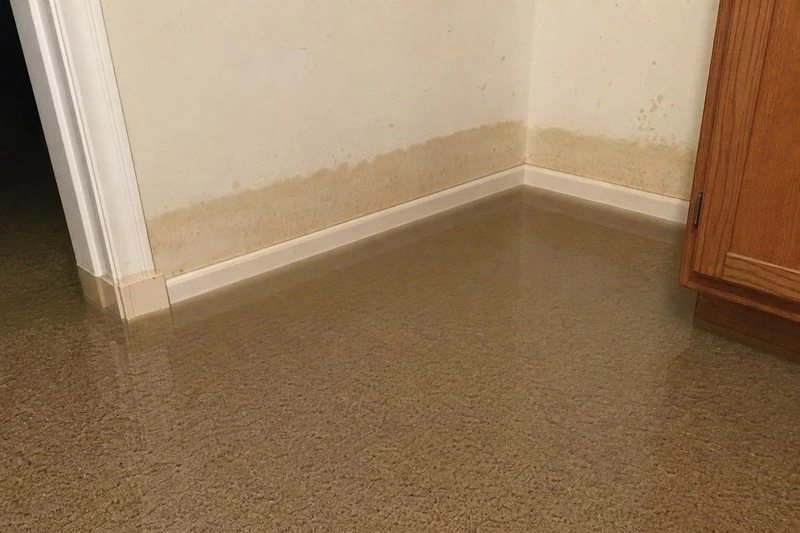
Finishing the Floor by Pulling Standing Water Out of a Millcreek Home
You do not have to find the leak before you call us. That belief keeps people behind a water heater with a flashlight while the water walks under the baseboard. Tracing the source is our work once we arrive, and it is the quicker half of the visit.
The one thing that matters in the first hours is getting the standing water off the floor. Every choice after that becomes simpler and less destructive. Tell us which room is under water and how deep it sits, and leave the rest to us.
A portable extractor is a wet vacuum with a wide head that we walk across the floor. Over carpet it does the heavy lifting in slow overlapping passes. A squeegee herds the shallow edges toward the head instead of chasing them.
Carpet also hides the real volume, because the pad underneath holds water and will not release it. So we lift the carpet, float it on directed air, and carry the soaked pad out in strips.
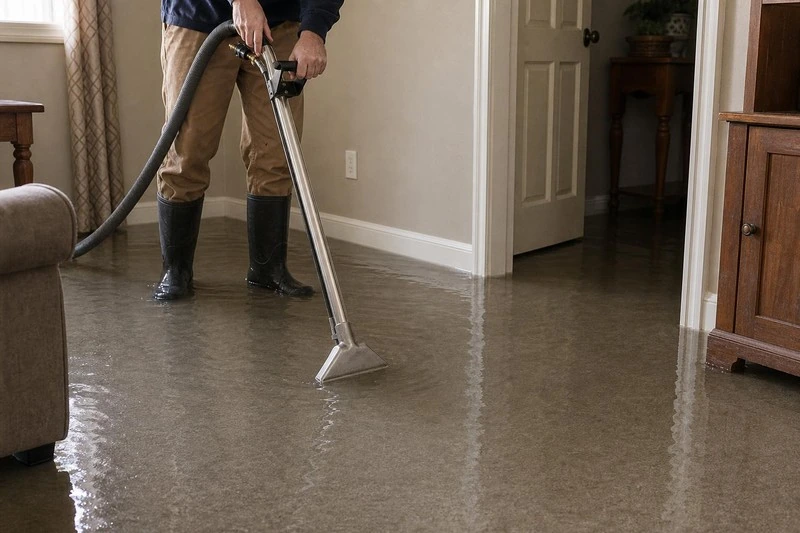
Where the extractor runs out of reach
Every one of those tools works a single plane, and that plane is the floor. Suction needs an open path, and a closed stud bay does not give it one. The strongest head we own cannot pull a drop out of a wall from the room side.
So the wet line on the wall is the honest boundary of floor extraction. Below it the gear does its job, and above it no vacuum head reaches. That upper half comes out through cut access and directed air instead.
The floor is finished before any wall is opened, because cutting drywall over standing water drops soaked gypsum straight back in. That single mistake turns a controlled extraction into a mop-up.
Hard floors change the tool, not the ceiling on it
Tile, vinyl plank and hardwood send us to different equipment for the same reason. Drying mats seal against a finished floor and draw moisture up through the boards.
A hardwood panel system covers a wider span of the same problem. Neither one climbs a wall, so the boundary above the baseboard sits where it always did.
Causes You Can See on the Floor and Causes You Cannot
Millcreek holds 27,546 housing units, and 64.2 percent of them predate 1980. The 1950s account for 5,485 of that total, with another 4,794 from the 1970s and 4,566 from the 1960s.
Older stock fails in older ways, and 15,247 of the units here stand alone on their own lot. Most of what we get called for announces itself on a surface. A water heater lets go at the bottom of the tank and empties onto the slab.
The braided supply line behind a washing machine or under a dishwasher can run unattended for hours. A toilet or a sink overflows and the water finds the doorway. A sump pump that quits turns its own pit into a fountain.
Sewer and drain backups surface at the lowest floor drain, and contaminated water changes how we handle the whole room. Everything absorbent it touches becomes a disposal decision rather than a drying decision.
Outside water arrives by other routes, and snowmelt and storm runoff pool against a foundation before pushing in at grade. The city of Millcreek's stormwater program page covers that side of it.
Seepage moves through the concrete itself, and it does not need a storm to do it. A sprinkler or irrigation backflow can stack real volume against a house before anyone notices.
The four that start inside the framing
- A burst or frozen pipe letting go inside a stud bay, wetting drywall from behind.
- A roof leak tracking along a rafter well before any stain reaches a ceiling.
- An ice dam backing meltwater under the shingle course and into the eave.
- A swamp cooler, the evaporative cooler on the roof, dripping down its own duct chase.
Those four saturate the framing before they reach the floor, so a small puddle can mean a wide wet area overhead.
Walls Dry on a Different Schedule Than the Carpet Did
Once the floor is clear, air movers and dehumidifiers go in and the room gives its moisture back. Structural drying of an open room is the straightforward part.
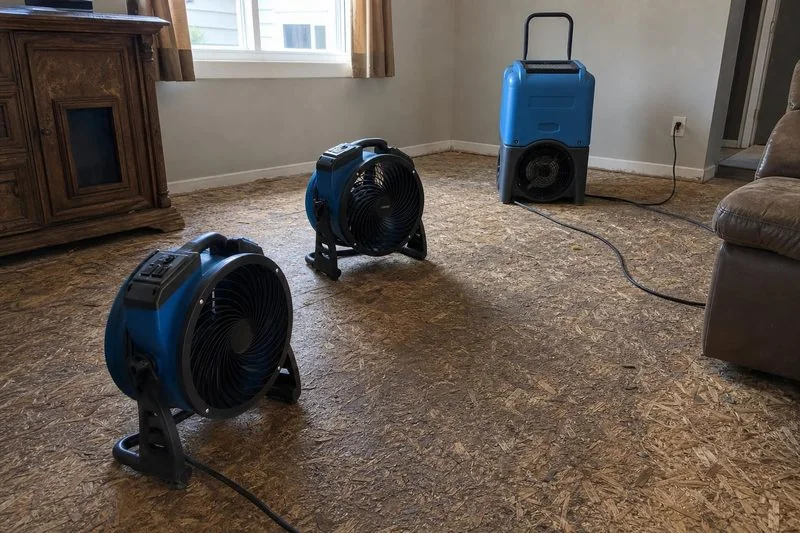
Air that gets inside the bay, not just past it
A closed bay is a different problem, because blowing air across drywall dries the paint and nothing behind it. The framing, the insulation and the back of the board stay exactly as saturated as they were.
So we open access below the wet line and push air straight into the bay. How long that takes depends on what the water reached and how long it sat.
The Environmental Protection Agency's guidance on the main ways to control moisture in a home is worth reading afterward. Keeping a house dry is not the same skill as emptying one.
Drywall Comes Off in a Strip, and Most of the Room Stays
The cut is smaller than people picture. Drywall comes off in a horizontal strip above the wet line, and the baseboard goes with it. Framing dries, tile and hardwood usually dry, and painted trim often cleans up.
What does not come back
- Carpet pad, which takes on water and refuses to release it.
- Insulation that has slumped away from the top of the bay.
- Particleboard furniture legs, swollen past the glue line.
- Drywall below the wet line, taken off in a clean strip.
- Anything paper-faced that sat in sewage or other contaminated water.
- Laminate flooring already lifting at the seams.
Before any of that, move what cannot be replaced. The box of home movie reels in the corner of a basement family room outranks every square foot of pad here.
Canyon Rim to Brickyard, and the Drop Between Them
Millcreek is not flat, and the slope decides where the water ends up. Canyon Rim sits at 4,618 feet and the city as a whole reads 4,557. Brickyard sits lower at 4,331, and Olympus Cove is the high end at 5,415.
The ZIPs and the claim record here
We cover 84106, 84107, 84109, 84117 and 84124, and only 84109 belongs to Millcreek by itself. Its entire federal flood-insurance history amounts to four paid claims, the earliest with a date of loss in 1983 and the latest in 2025.
Almost none of the water we pull out of houses in this city ever arrived from a river. It came from equipment, plumbing and weather that a building could not keep outside.
We are based a mile from the nearest Millcreek boundary, so this is close-in work. That work carries next door into South Salt Lake, Murray and Holladay. Every other city we reach has its own page, and our map ties them together.
One crew and one load-out handle water damage restoration on the Salt Lake City side across the valley. If the water is already ankle-deep, getting it off the floor comes before another hour goes on it. If it is standing in a finished downstairs room, read what happens next below grade.
Thawing Is When You Find the Leak, Not the Cold Snap
Honestly, you cannot tell from the room side with any confidence. A musty smell, a soft spot, or a stain that keeps returning through fresh paint are reasons to look. The only answer worth acting on comes from an independent assessment by someone not paid to remove what they find.
It thaws on its own once the house warms, and that moment is the problem rather than the relief. Ice splits copper and cracks fittings while it is still solid, and nothing leaks until pressure returns to the line.
Coverage usually turns on whether the growth followed a sudden water loss the policy already covered. It also turns on whether the water was handled promptly, and your carrier makes that call, not us. Photograph the water while it is on the floor, keep the invoices, and open the claim early.
One Number Reaches the Whole Crew
The line rings through to a person at 3 a.m. exactly as it does at noon. Call Water Damage Restoration Salt Lake City and you hear an honest arrival time, not a script.
The Floor and the Cavity Are Two Different Jobs.
Water on the floor and water in the wall leave on different schedules, so we load for both before we head out. We cover Canyon Rim and the rest of Millcreek, and somebody is on the line all night.