
Water Damage Restoration Salt Lake City, UT
Water on your floor right now? Call (801) 903-2904 and somebody in the valley answers, whatever the hour.

We come out and pump the standing water off your floor. Then we remove the material that will not recover and dry the structure that stays, wall cavities and subfloor included. That entire sequence is water damage restoration, and calling (801) 903-2904 starts it immediately.
Get everyone off the wet floor first, stay well away from anything electrical in that room, and then call us.
If the water is still running, shut it off at the valve whenever you can reach it safely. Never wade through standing water to get to a shutoff.
What to Do When There Is Standing Water in Your House
Your floor is wet, the edge of it keeps moving, and you have no idea yet how bad it is, which is a completely normal place to be standing right now.
Here is the part that actually matters: the water keeps moving while it sits. Every hour of that, more of it soaks into your subfloor, your baseboards and the framing behind your walls.
So the clock is the one part of this you still control, which is why calling immediately matters. We load the truck for your particular situation, and then we drive.
We answer this phone 24/7, so tell whoever picks up what is happening and we start loading for it. Call (801) 903-2904.
Do These 3 Things Before We Get There
You do not have to wait on us before you start, and all three of these are safe as well as genuinely useful.
- Get people and pets out of the room. Wet floors are slick, and you cannot see what the water is covering.
- Stay clear of anything electrical. Do not touch cords, plugs, switches or a floor outlet in a wet room.
- Shut the water off if the valve is easy to reach. Skip it entirely if you would have to wade.
Then stop there and leave the remainder to us, because pulling up carpet or dragging soaked furniture around usually creates more damage than it prevents.
We Extract the Standing Water Off Your Floor First
This is the main job, and every other stage of the restoration waits until the standing water is gone.
First we find out how far it traveled, because water always spreads wider than it looks. We read the walls and floor with a moisture meter, mark the wet line in pencil, and work to that line for the rest of the job.
The equipment we use to lift the water
- A truck-mounted extractor parks at your curb, and we run hose in to the wet room.
- A submersible pump handles anything sitting deep, like a flooded basement or a stairwell.
- A weighted extraction wand pulls water up out of carpet in slow, overlapping passes.
- A squeegee on tile and hardwood drives the water into a pool so the wand can lift it.
All of it leaves your house on a machine, because a mop and a bucket cannot possibly move this much water.
Carpet, padding and hardwood floors
Water trapped underneath a floor has nowhere to evaporate, so we lift the covering and open the pocket beneath it.
The padding underneath your carpet is almost always unsalvageable, so we cut it into strips, roll it and bag it at your door.
Keep your feet out of that room while we work, because the tack strip around the perimeter is a continuous row of exposed nails.
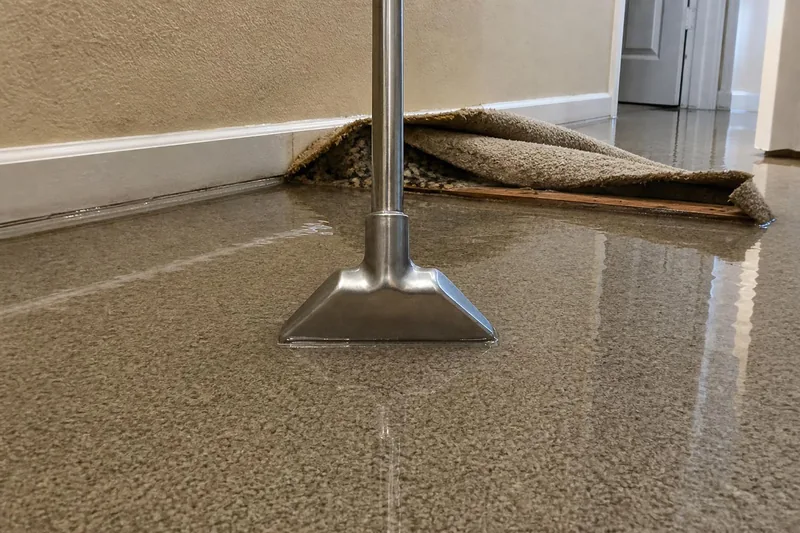
Is it on your floor right now? Call (801) 903-2904 and we start the minute we walk in.
Then We Dry Your Wall Cavities and Subfloor
The water you can see is the easy half, and the water inside your walls is the half that eventually grows mold.
We set air movers low along the wet surfaces so they strip the saturated air off the material. Dehumidifiers then collect that moisture as it comes off, and a hose carries it out to a drain.
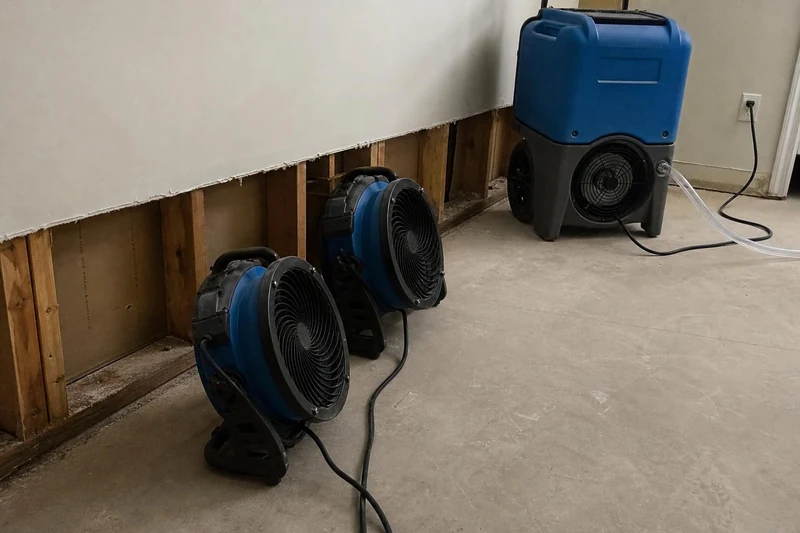
Behind the baseboard we drill a line of small holes into the stud bays. That delivers airflow into the cavity without us removing the entire wall.
Why dry Utah air will not save you
The air outside is famously dry here, so people naturally assume a wet house will simply dry on its own, and unfortunately it will not.
A closed wall cavity never meets that dry air. Neither does the sealed box under your cabinets or the space beneath a glued-down floor. Any material we leave wet in those pockets is where a mold problem starts.
So we open those pockets, drill them and force air through them instead of trusting the local weather.
Living with the equipment
We will be straight with you: your house stays loud and uncomfortably warm until we pull the equipment out.
Please do not switch them off overnight, because that room stops drying the moment you do and the schedule loses a full day.
We leave them running until the wet materials read the same as an unaffected part of your house.
Water Damage Cleanup, Water Restoration, Water Damage Repair: Same Work
People search for this a dozen different ways: water damage cleanup, water restoration, water mitigation, or water damage repair.
The wording changes nothing we bring to your door, because we perform the same work in the same sequence every time.
One of those terms is worth pulling apart, though. Water damage repair is really two jobs stacked together. We do the first one: we extract the water, remove what is soaked through, dry the structure and document all of it as we go.
Another trade then puts your walls, trim and flooring back afterward. That is a separate bill, and we tell you so up front.
Water Damage Salt Lake City: Every Kind of Job We Handle
Most of our week is water inside homes. A supply line under a sink, a water heater that split at the bottom, a washer hose, a toilet on the clean side.
Is it on your floor this minute? Start with emergency water removal and call while you read it.
Water that arrived from outside is a different animal, because it carries in whatever it crossed on the way. Runoff, storm water and spring snowmelt are all flood damage restoration.
Water that ended up downstairs instead has its own page: help for a flooded basement.
Sewage reverses the order and changes the gear we wear. We contain the room, remove the porous material, sanitize the space, and only dry it last. That job is sewage cleanup.
For a shop, office or warehouse we run the same sequence zone by zone so you can stay open. That side is commercial water damage restoration.
A fire is a water job too. Suppression water goes in fast and soaks rooms the flames never reached. We cover that as fire damage restoration.
If you are not certain which of these you are dealing with, call (801) 903-2904 and we will work it out together on the phone.
What Makes One Water Damage Job Cost More Than Another
Nobody can price water they have not walked, but we can tell you exactly what moves the number, because the same four factors drive every job in this city.
- Wet floor area. We measure area rather than depth, so a thin spread across three rooms beats a deep puddle in one bathroom.
- Hours on the clock. Everything porous keeps drinking the whole time it waits, and this is the part you can still change.
- How far in it got. Water sitting on a surface is a small job. Water inside wall cavities and under finished flooring is not.
- The category of water. Clean supply water is the best case. Drain water or outside water means we clean the space before we dry any of it.
Rebuilding is the part people forget to separate out. We extract, we remove and we dry, and a separate contractor prices putting the room back together.
Call (801) 903-2904 and we will tell you which half of the job is ours before anyone opens a wall.
Watch How We Pull the Water Out
About a minute on what happens after you call, from the first extraction pass to the drying equipment going in.
We Cover All of Salt Lake City, Sugar House to Rose Park
We work the entire city, and your address only changes the length of the drive.
Downtown sits in 84101 and 84111, Central City runs across 84111 and 84102, and Liberty Wells and Ballpark both fall inside 84115.
Over on the west side, Glendale and Poplar Grove share 84104 while Rose Park and Fairpark share 84116. Sugar House runs across 84105 and 84106.
Yalecrest and Wasatch Hollow sit across 84105 and 84108. The Avenues, Capitol Hill and Federal Heights are all in 84103, and we cover 84112 and 84113 the same way.
Spring snowmelt and winter pipe failures
Spring runoff is the season that catches this valley out, and it never needs a river to do it.
Salt Lake City Public Utilities publishes what its stormwater system covers, and that responsibility stops at your property line. Everything past the sidewalk is yours, and then ours.
Winter takes the other half of our year, when a supply line in an unheated space or an exterior wall opens up at the worst possible hour.
The winter weather guidance at Ready.gov is the plainest checklist we know for preventing that. When it happens anyway, call us.
Salt Lake County does not stop at the city line and neither do we. We run water damage restoration in West Valley City week in and week out, and the same crew reaches Murray and Sandy. Every city we reach is listed on our service areas page.
Ask Us Any of This When You Call
Days rather than hours, and the wall itself sets the pace. An open stud bay with the baseboard off gives its water up quickly once air is moving through it. A closed cavity packed with wet insulation takes far longer, and so does a wall standing on a cold slab. We put a meter on the same bays each time we come back, then shift machines off the ones that have finished and onto the ones still holding water.
Often, yes. Boards that cup surprise people by flattening back out once we take the water from underneath them. What decides it is how long the water sat and whether it soaked into the subfloor below. We lift the covering where we have to, aim air movers along the length of the boards, and let dehumidifiers pull that moisture out of the room. Boards that have crowned or opened up at the seams are usually past saving, and we say so on the first visit.
They are, as long as the standing water is already gone and somebody aims them properly. An air mover is not a dryer. It strips the damp skin of air off a wet surface so the material keeps handing its water up, and a dehumidifier then takes that water out of the room. Two fans in a closed room with a dehumidifier beat six fans and an open window. Pointed at water still lying on a floor, they make noise and nothing else.
Yes, and it finds the part your eyes miss. A pin meter reads the moisture inside wood and gypsum, and a pinless one sweeps a wall without marking it. We use both to trace how far the water traveled, mark that edge in pencil, and work to it for the rest of the job. A wall can look and feel perfectly normal at chest height while the bottom foot of it is soaked through.
The soaking starts immediately, and the damage you can see arrives later. Carpet padding, drywall paper and particle board pull water in the moment they touch it, so your material is already changing while the floor still looks like a spill. Swelling, cupping and staining show up over the hours after that. The gap between the two is why we would rather get a machine on your floor now than talk about it tomorrow.
Not always. An ice dam only becomes our problem once the backed up meltwater gets past the roof edge and into the building itself. Then it shows up as stained ceilings, wet insulation and water tracking down the inside of an exterior wall. We handle the water indoors: we extract it, take out the soaked insulation and drywall, and dry the cavity behind it. Get a roofer onto the dam itself while we deal with what came through, because the meltwater keeps arriving until somebody clears the ice.
We Answer This Number Every Hour of the Year
The phone is the fastest thing on this page. Call and you get a person who asks what room, how long, and whether it is still coming in. Then they tell you what we are loading.
The Sooner We Extract, the Less Comes Out of Your Walls
Tell us what room it is in and how long it has been loose, and we will tell you what we are bringing. We answer (801) 903-2904 at any hour.