
Water Damage Restoration Holladay, UT
Water settles in the tightest part of the room, under the freezer and under the water heater. We cover Holladay seven days a week, and we shift whatever will move before a hose comes off the truck. Reach us and we bring the hands to move it.
Holladay basements are real basements, with real utility rooms and heavy equipment standing flat on the floor. Water that gets loose upstairs ends up down there.
When a Crestwood rambler takes on water, the puddle does not politely stay in the open. It runs to the lowest, tightest part of the room and settles under something nobody can lift. Whatever let it loose, that water still has to be out of the building today.
If water is standing right now, cut power to the wet rooms at the breaker. Only do that if the panel is dry and you can reach it from dry ground. Put shoes on and lift anything light and absorbent onto a stair or a countertop. Then reach us on the phone, name the room, and say how deep it looks.
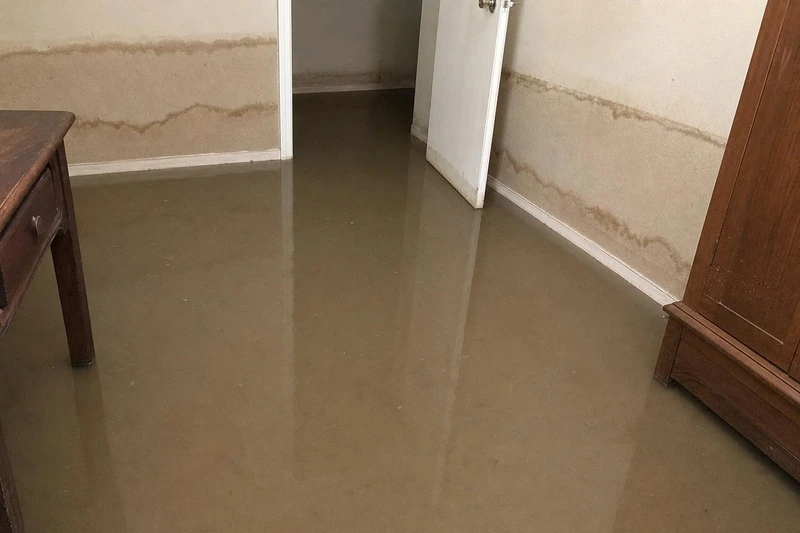
Getting the Water Out When Something Heavy Sits on Top of It
Extraction is a reach problem before it is a volume problem. A portable extractor pulls whatever the head can touch, and that head is a few inches of plastic on the end of a hose. Anything it cannot slide beneath keeps its own footprint wet.
A water heater standing in a soaked utility room holds a ring of water under its base long after the open slab is clear. That ring feeds moisture back into the floor around it for days.
So the order of work runs backward from what most people expect. We move what can be moved before general extraction starts, because coming back to a wet footprint means re-drying everything we already dried around it. There are three ways to get at water under a fixed object, and we use them in that order.
Move what can be moved, first
Most of what blocks a basement floor can be shifted by two people in twenty minutes. We empty a freezer and walk it out the door. We isolate a washer and pull it forward onto dry concrete.
This is what we look for before a hose comes off the truck.
- A full chest freezer in the corner of the utility room.
- A water heater sitting in its drip pan.
- The furnace stand and the return duct beside it.
- A slate pool table in a finished basement.
- A washer and dryer pushed back against the standpipe.
With that floor open, the portable extractor works it in overlapping passes and the standing water leaves quickly. Clear space is the whole reason it goes fast.
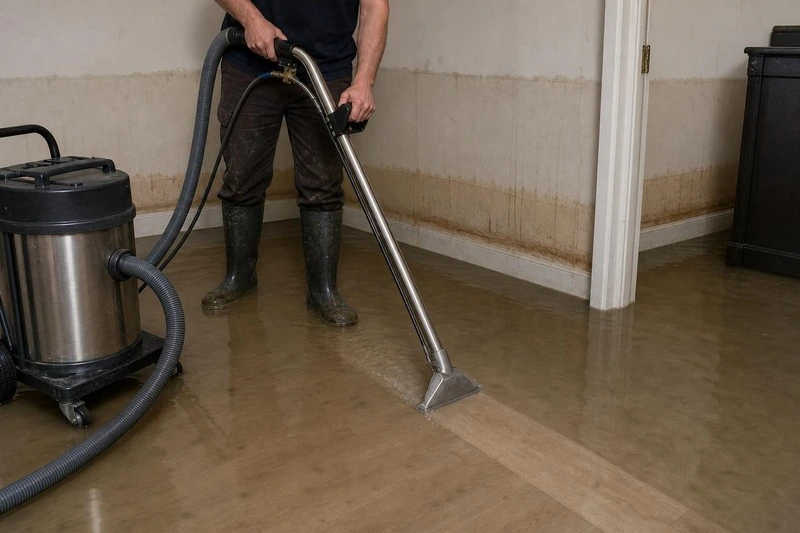
Reaching what will not move
Some things stay put. A furnace is wired and vented in place, a tiled shower base is set in mortar, and that slate pool table is not coming apart today.
For those we switch to a low-profile extraction wand, thin enough to work in from the edge and pull what sits under the lip. It will not get everything under there, and we do not pretend that it does.
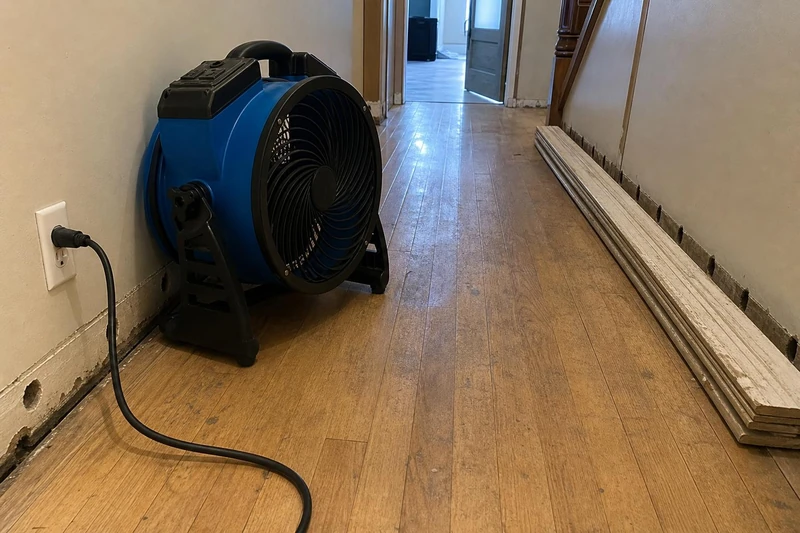
What the wand cannot reach, moving air has to finish. We aim an axial fan into the gap so air actually travels under the object. A dehumidifier runs beside it, so the moisture that comes up leaves the room.
All the Ways a Holladay House Lets Water In
People usually call already sure of the cause, and they are usually right. What it changes is which water we treat as clean and which we treat as contaminated.
What an older Holladay house lets go
Seven in ten homes here were finished before 1980, two of every three are detached houses on their own lot, and only 25 of the city's 12,561 units have gone up since 2020. That is a settled, mature housing stock, and mature houses tend to fail from the inside out.
The failures we see most are the ones plumbed into the building. A burst pipe or a frozen line in an outside wall fills a floor faster than any storm. So does a water heater that splits at the seam, or the supply line behind a washing machine or dishwasher.
A toilet or fixture overflow does the same on its own floor. A sewer backup or a drain backup is worse, because that water is contaminated. And in a house still running a swamp cooler, the evaporative unit and its water line can drip into a ceiling for weeks before anyone spots it.
What the weather and the yard push in
The rest arrives from outside, and it arrives in a hurry. Snowmelt and storm runoff pool beside a foundation and find the seam where the floor meets the wall. It shows up as a wet line along the base of a finished basement.
An ice dam backs melt up under the shingles and drops it into a ceiling. A roof leak does the same thing without the ice.
Basement seepage and groundwater sit on this list as an event: a melt or a storm pushes water in, the ground drains, and it stops. That water is ours to take out. Holladay keeps its runoff and drainage information on the city stormwater page at Holladay Public Works, which is worth reading once your floor is dry.
The last two are mechanical. A sump pump failure turns a working basement into a flooded one in a few hours. A sprinkler line or an irrigation backflow device can let go on a large Holladay lot and run all night into a window well.
Drying a Holladay Basement After Extraction
Pulling the standing water out ends the flooding. It does not end the water, because material that sat in it for hours holds far more than the surface admits to.
Drying is placement as much as it is machinery. Air movers go where they can push air across wet material, not into the middle of the room. The dehumidifier goes where the wet area is widest.
- Air movers angled low along the wall line.
- A dehumidifier set where the wet area is widest.
- A desiccant unit for the closed rooms and the crawl space.
A basement here takes several days of structural drying, and the machines run through all of it. We come back and move them inward as the wet area shrinks. A fan aimed at concrete that already dried does nothing for the wall bay two feet over.
What Comes Back and What We Haul Out
Most of a finished basement is salvageable when the water leaves fast and the drying starts the same day. Hard flooring, framing, and solid wood furniture usually come through it fine.
Some material never does, and hanging onto it only slows the drying for everything else. These are the things we expect to carry out of a Holladay basement.
- Carpet pad, first thing out the door.
- Wet drywall from the baseboard up past the line.
- Batt insulation that has slumped in the bay.
- Chipboard shelving and its swollen edges.
Contaminated water changes that math completely. Anything soft and absorbent that a sewer backup touched comes out, because it cannot be cleaned where it sits.
Where We Work in Holladay
We cover all three Holladay ZIP codes: 84117, 84121, and 84124. Crestwood sits in 84117 at roughly 4,368 feet, Holladay North sits in 84124 at roughly 4,462 feet, and the city figure lands between them at 4,433 feet.
The city limits carry FEMA flood zones A, AE, and X, and the AE portion includes mapped floodway. Salt Lake County's flood control engineering division manages the channels and detention basins that drain this part of the county.
The Cooler on the Roof and the Water on the Floor
A working cooler is fine. A neglected one is a slow leak sitting directly above your ceiling, and that is the version we get called about. The unit holds a pan of water the whole time it runs, so a stuck float drips into the framing for weeks.
Service life depends on the unit and on the care it gets, and servicing them is not our trade. What we notice is that the leaks come off older roofs, and most of this city's housing predates 1980. If yours has run for years with nobody opening it up, watch the ceiling underneath it.
We do, and we start on it the minute we get through the door. Our crew moves whatever stands in the way, then works a portable extractor across the floor in overlapping passes. Call (801) 903-2904 and tell us what is standing in the water, since that decides which gear we load.
Call Before the Water Finds Another Room
We answer at any hour, and an early call means less material leaves the house at the end. Tell us the room, the depth, and what is standing in the water, and we load the truck for that.
You can read how we handle standing water, or what a soaked lower level actually takes. There is also the wider picture of our water damage restoration across Salt Lake City.
Cottonwood Heights shares our closest edge, with Millcreek and Murray a few minutes past it. We map how far out we go on one page, and the number is (801) 903-2904.
One Number Reaches the Whole Crew
The line rings through to a person at 3 a.m. exactly as it does at noon. Call Water Damage Restoration Salt Lake City and you hear an honest arrival time, not a script.
What Is Standing in the Water Down There?
Check what is sitting in the water and whether the panel is dry enough to reach. We load the truck for the objects you name, so say which ones will not move.