
Water Damage Restoration South Salt Lake, UT
When you closed the valve, did the water stop, or is the pipe run above still draining into that room? Tell us which on the phone, because it changes where we start.
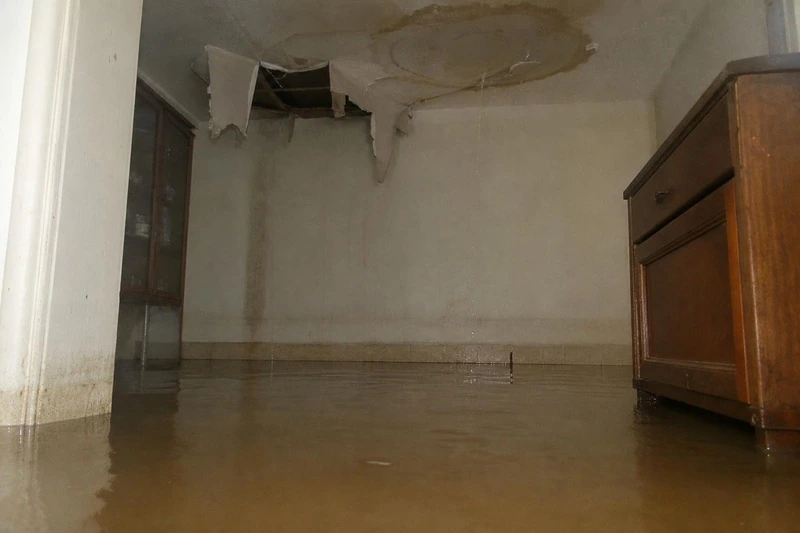
Pulling the Standing Water Out of a South Salt Lake Building
Cut the power to any room where water is sitting near an outlet, then lift the soft things off the floor. Leave the heavy furniture standing where it is. The water under it is our problem, and dragging a soaked couch across a wet floor only finishes the couch.
Then call us, because removal sizes everything after it. Every hour it stays down, the water works further into material that was dry.
Lift the paper first. Loose documents and medicine sit lower than you think, soak faster than furniture, and nobody reissues them for you. Everything heavy or attached to the building can wait for us.
The room is holding more water than it shows
Shutting the water off stops the source. It does not empty what is already inside the building, and that holds true whether the water came from a pipe, a roof, or a drain.
The puddle you are looking at is the small half of the problem. Carpet pad, insulation, and the bottom of the wall hold several times what the floor shows, and they give it back slowly.
So a surface can read dry an hour later and still be feeding the room underneath it. We probe the wall base, the subfloor, and the low corner with a moisture meter before deciding where to start pulling.
Why we work the low point last
We start the extraction as soon as we are through the door, but we stage it. Upper floors and the ceiling come first, because they still feed every room beneath them.
The lowest room is where all of it lands. We let that drain-down finish into one controlled low point instead of chasing water across a floor that keeps getting wet again.
Then the extraction wand goes into that low point. A wand pulls water up through carpet and pad under vacuum, which is work no wet vac can do on a soft floor.
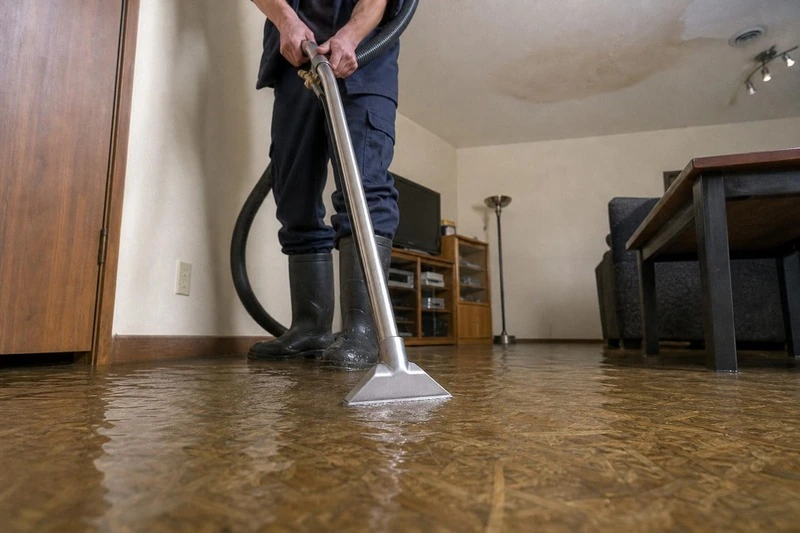
A wet vac still earns its place on tile, sealed concrete, and inside a cabinet base.
Old Pipes, New Appliances and Weather on a South Salt Lake Floor
Of the 11,704 housing units in South Salt Lake, 50.9 percent went up before 1980, including 1,685 from the 1970s and 1,657 from the 1950s. Much of this city runs on hardware decades into its service life.
In that older stock the water usually starts with a burst or frozen pipe in an unheated crawl space, a water heater letting go at the tank, or a swamp cooler leaking down through the ceiling.
The newer half is stacked rather than detached, with 2,471 units finished between 2010 and 2019 and 522 more since 2020. There the failures are appliances and fixtures. A washing machine or dishwasher supply line splits, or a toilet overflows and runs unheard.
Only 36.7 percent of the structures here are single-family detached, so most of these buildings share floors and ceilings. Water leaving one unit becomes the ceiling of the unit below it.
Water that arrives from outside the building
The rest comes up from below or in from the weather. A sewer or drain backup and a sump pump failure both put water across a basement floor, and basement seepage does the same once the ground outside takes on more than it holds. A flooded basement collects whatever the rest of the building lets go.
From above, snowmelt and storm runoff, an ice dam at a cold roof edge, a plain roof leak, and a sprinkler or irrigation backflow all end the same way, with water on a finished floor.
South Salt Lake runs its own storm drains and catch basins, and the city's stormwater division page covers how that network carries rain away. When a storm arrives faster than those pipes clear it, the surplus finds the lowest opening nearby. Flood maps put parts of the city in zones AE, AH and X.
Which one it was changes the order we work in and little else. The extraction is the same job whether the water came off the roof or out of a tank.
Drying the Walls and Floors the Water Soaked
Once the standing water is gone, we angle fans across the room so the air sweeps every wet surface. A dehumidifier shares that room and takes the water out of the building.
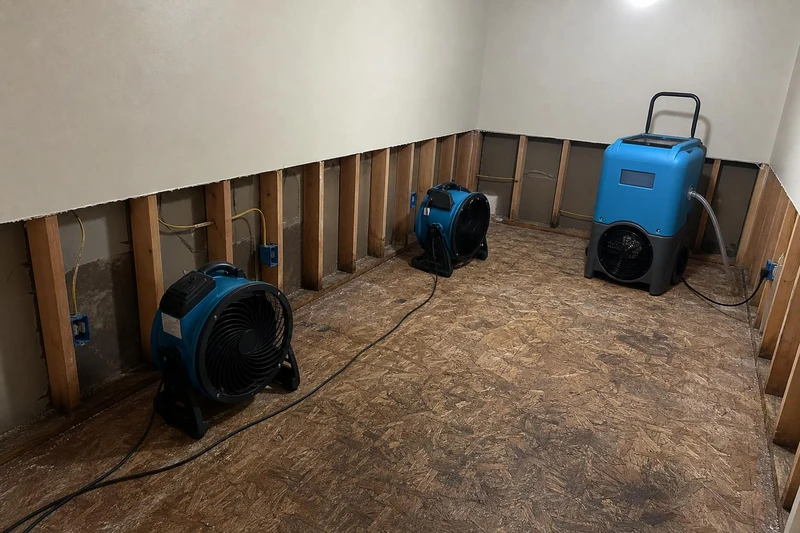
The equipment runs for days rather than hours, and the wettest material sets that number. Insulation and carpet pad release water far slower than a floor does, so shutting the fans off overnight hands the day back.
We stop when the probe agrees at every point we mapped on the first pass. Before that, a dry surface is only telling you about the top eighth of an inch.
What Dries in Place and What We Carry Out
Every call on wet material comes down to how much it took on and how long it held. Dense material sheds water, and open material stores it.
- Framing and subfloor. Solid timber almost always dries in place once the water around it is gone.
- Carpet pad. It holds many times its own weight in water, so it comes out nearly every time.
- Carpet itself. Often worth saving when the water was clean and we reached it early.
- Insulation. Once it is saturated it stops insulating and stops drying, so it goes.
- Drywall. We cut a line above the water mark rather than gutting an entire wall.
- Anything the sewage reached. Soft material that took on drain water leaves the building.
Leave the wet material where it is until we see it
Pulling wet drywall or rolling up carpet before we arrive pushes water into rooms that are still dry. It also erases how far the water traveled, which is what sizes the job.
Where We Answer in South Salt Lake
We cover 84106, 84115 and 84119, and not one of those ZIP codes is South Salt Lake's alone. The address on your bill may read Salt Lake City, and it changes nothing about the work.
South Salt Lake counts 10,707 occupied homes and only 4,062 are owner-occupied. At 37.9 percent that is the lowest owner-occupancy anywhere we cover, and it comes with a lot of shared walls and shared ceilings.
Three things to tell us when you call
- The floor and the unit. A street number gets us to the curb, and the unit number gets us to the water.
- Where it is landing. Name the room taking the water and the room sitting directly under it.
- How we get in. Name the door to use, and say whether anything is locked between it and the water.
When runoff is moving across the whole county, the Utah Division of Emergency Management posts the statewide flood and disaster updates. Our part is narrower. We take the water out of your building and dry what it reached.
Millcreek next door gets the same crew, and so does every other water damage call we take across Salt Lake County. If your address sits just outside these ZIP codes, check whether we come to your town.
Call (801) 903-2904 and tell us which room the water is in and what sits underneath it.
How Water Damage Restoration Actually Goes
Most of it can be. What decides it is how much water the material absorbed and how long it held on. Framing and hard surfaces usually dry in place, while carpet pad, insulation and saturated drywall normally leave the building.
We stop the water still arriving, remove everything standing, then dry the structure and whatever stayed behind. The order is the part people get wrong. We work the upper floors before the lowest room, because that low point still collects whatever drains out of everything above it.
Get the water out fast and keep it away from material that is still dry. Cut the power near standing water, lift the soft items onto a hard surface, and leave wet drywall hanging until we see it. After that it takes extraction equipment and moving air.
One Number Reaches the Whole Crew
The line rings through to a person at 3 a.m. exactly as it does at noon. Call Water Damage Restoration Salt Lake City and you hear an honest arrival time, not a script.
We Work the Low Point Last
Water leaving one unit becomes the ceiling of the next one down, so tell us which floor is taking it and what sits directly underneath.