
Why Is My Swamp Cooler Leaking?
Most of these leaks are a worn pad or a stuck float. If it soaked the ceiling below, call us.
An evaporative cooler holds water on purpose. Most people around here simply call it a swamp cooler, and the two names describe the same machine.
A small pump keeps a stack of pads wet. A fan pulls dry outside air through those wet pads, and the water evaporates into the airstream. The air arriving in your rooms is noticeably cooler than the air outside.
So the cabinet sitting on your roof is really a shallow water reservoir with a fan bolted to it. Anything that holds water can eventually send it in a direction nobody planned for.
Salt Lake City's summers keep these coolers running hard, and we handle the water damage restoration when one lets go. These calls arrive steadily through the hot months.
The serious part is almost never the cooler itself. It is the water that traveled into the house before anybody noticed.
Here is what actually leaks, in roughly the order we encounter it.
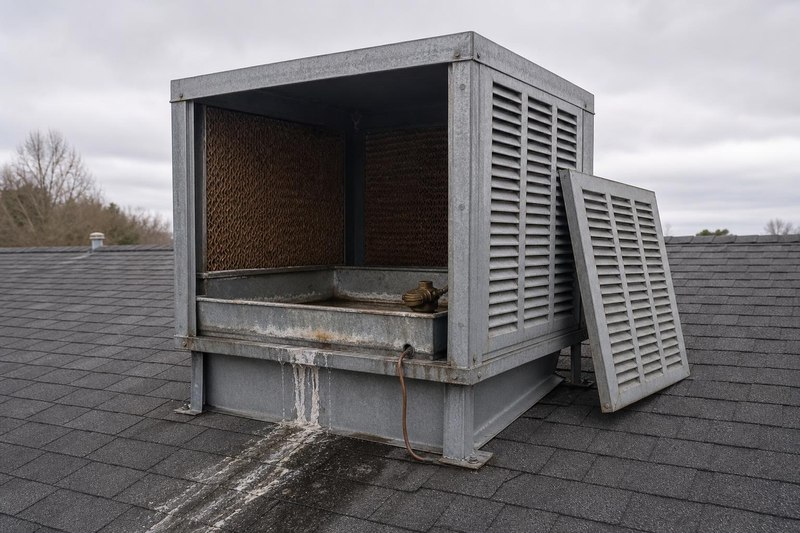
Pads that stopped absorbing water are the first thing to check
Begin at the pads. Mineral deposits accumulate on them over a season and gradually seal the surface. Water then sheets down the outside face, misses the pan below, and finds the seam at the bottom of the cabinet.
This one you can see for yourself. Remove the side panel and look for white crust, thin patches, or a pad that has slumped away from its frame. Water striking bare metal is the entire problem.
The distribution tubes along the top deserve the same attention. Those small holes deliver water evenly across the length of every pad. Mineral buildup plugs some of them, so the remaining holes push far too much water into one position.
Replacement pads settle all of it. A cooling service technician swaps them out and the dripping stops with them. That job belongs to the technician, and the water damage underneath belongs to us.
The Department of Energy guide to evaporative cooling systems explains what every part does and where these units typically give out. It is a short read. It also helps you describe the symptom clearly when you call a technician about it.
Float valve set too high fills the pan until it overflows
The float valve determines how deep the water sits in the reservoir. Set it too high and the pan runs over every time the pump kicks on. Set it right and the water settles well below the lip.
Examine the rooftop unit's overflow pan for a wet ring around the outer edge. That ring tells you the water went over the side. A puncture in the cabinet metal leaves a very different mark.
A technician bends the float arm back down in a couple of minutes. It is the most common adjustment on the whole cooler. It also drifts quietly as the summer wears on.
The overflow pan underneath is only a backstop. It buys a little time and steers the spill toward a drain line. Once that drain plugs, the pan simply fills and delivers the same water onto the roof deck.
A tired pump seal or a split supply hose produces identical symptoms from a different spot. Both of them discharge into that same pan. Both are ordinary wear parts that a technician carries as stock.
Most installations also carry a bleed line. It steadily releases a small amount of water, so minerals never concentrate inside the reservoir.
That line can plug up, and it can also discharge onto the wrong section of the roof. Then the surface stays wet, and the homeowner reasonably assumes a leak.
Summer heat is when these leaks surface across Salt Lake City
A cooler trades water for cool air, and it only pays off where the air is thin and dry. Salt Lake City gives it exactly that.
Salt Lake County homes run these units hard once the heat settles in. A humid coastal metro could never run them successfully. That is also why the leak catches homeowners off guard.
That is what makes this leak different. The unit is a water appliance parked outdoors on the roof, directly above finished rooms. It runs unattended for months at a stretch, and nobody climbs up to check on it.
A discolored ceiling appears dry again within a day or two. The framing and insulation behind the drywall stay saturated much longer.
That gap between what you see and what is still wet is why a small roof drip becomes a genuine restoration job.
Ceiling stains beneath the unit mean the water has been running a while
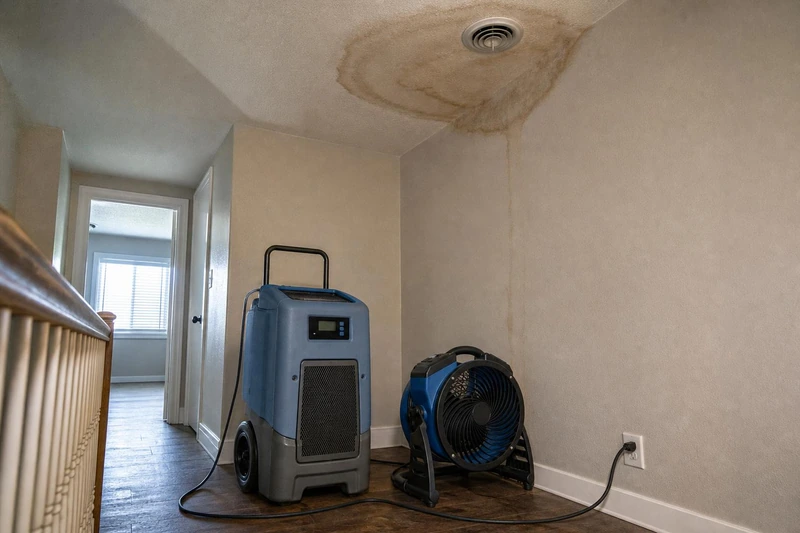
A brown ring on a hallway ceiling is what most homeowners notice first. By the time it appears, the water has already saturated the drywall and the insulation above it. A stain that size took days of steady dripping.
Water leaving a rooftop cooler follows the framing before it ever penetrates a finished surface. It travels several feet sideways and emerges well away from the unit. A stained hallway ceiling marks the end of that path. The original leak sits somewhere upstream of it.
This portion is ours. We open the wet ceiling, remove the saturated insulation, and dry the framing and the cavity above it.
We keep the equipment running until the material is dry all the way through. Our meter still reads wet on drywall that looks perfectly normal from the hallway.
The cooler itself remains with the cooling service technician. Two separate trades, and neither of us needs the other one's tools.
Call us at (801) 903-2904 and we can talk through whatever you are looking at. We cover this under the same removal work, regardless of which appliance leaked.
Shutdown before the first freeze prevents most of these leaks
Shut the water off, drain the reservoir, and clear the supply line. Water left in a line on the roof has nowhere to go once temperatures drop below freezing. The line splits quietly in the cold, and nothing shows at the time.
Then the pump runs again and that split becomes a steady drip. A good number of the leaks people call us about began as a shutdown that somebody left half done.
A proper seasonal shutdown comes down to five steps.
- Turn the water off at the shutoff valve and drain the reservoir completely.
- Clear the supply line so no water remains sitting inside it.
- Remove the old pads and allow the cabinet to dry before you close it up.
- Cover the unit so snow and rain stay off the pan and the motor.
- Close the vent inside the house so warm air stops climbing the duct.
Startup deserves the same care. Open the water slowly and watch the reservoir fill. Confirm the float really stops it below the lip before you leave the roof.
The EPA Fix a Leak guidance treats a leaking cooler exactly like any other household leak. Water is water once it reaches your floor.
If the dripping already reached drywall, a ceiling, or a floor, do not wait it out. Salt Lake City and the wider Salt Lake Valley are the ground we cover for water damage restoration.
We take that call at whatever hour you make it. Call (801) 903-2904, or see how we handle water damage across the valley.
Maintenance Questions We Get Every July
No. An evaporative cooler keeps its water in the reservoir and the pads, apart from the bleed line that drains a little on purpose. A damp patch under that line is ordinary. Water running across the roof, dripping from a duct, or staining a ceiling means the pan is overfilling, a pad is shedding water, or a seal has given up. Each of those is a routine fix, and none of them can wait.
It depends on the unit and on how consistently the owner maintains it, so no single figure covers every machine. The pads, the pump, and the float valve deteriorate first, and an owner replaces all three as routine maintenance. The cabinet and the motor usually outlast them by a considerable margin. A cooling service technician who opens your unit can tell you what yours has left. Whatever that answer is, the water it dropped inside the house is a separate problem, and it still needs drying.
Shut the water off at the valve first, so the reservoir stops filling while you look. Then examine three things: the water level in the pan, the condition of the pads, and the seal where the supply line enters the cabinet. Water above the lip indicates the float valve, crusted pads indicate a pad change, and a wet fitting indicates the seal. A cooling service technician resolves all three in one visit. If the water already reached your ceiling or your floor, call us and we will dry it out.
That Ceiling Is Holding Water Right Now
Phone (801) 903-2904 and say which floor the water reached. We will bring what it takes to dry the ceiling.