
Signs of Water Damage in Salt Lake City's Older Homes
Old houses hide wet longer than new ones. Found a stain you cannot explain? Call and describe it to us.
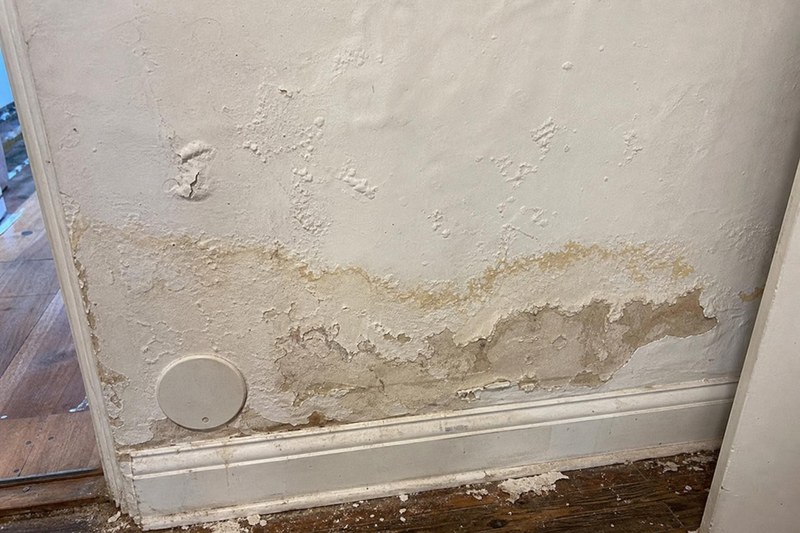
Press your hand flat on the plaster under the stain. If the surface gives at all, moisture has been sitting inside that wall for a while. A mark on an older wall is always late news.
We handle water damage restoration in Salt Lake City, and the calls from the older blocks often begin the same way. Somebody finds a soft spot, a musty smell, or a warm patch of flooring. Nobody heard a single thing.
Here is what that pattern often means. Something small has been leaking quietly for weeks, and the finish covering it hid the entire problem.
Galvanized Supply Lines Fail Before the House Does
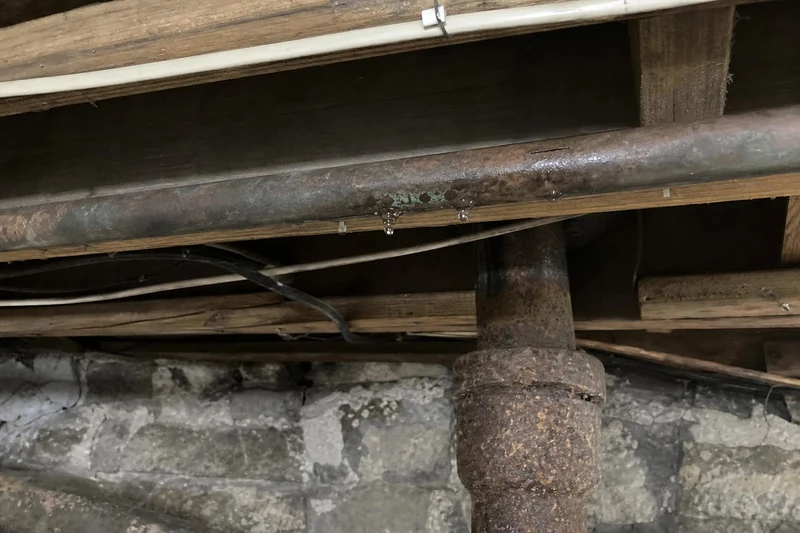
Galvanized steel was the standard supply pipe in American houses for decades, and it corrodes from the inside out. Zinc wears off the inside of the pipe, and rust builds up in its place.
You notice that as weak pressure at the shower long before any water shows on a floor. Then the pipe wall thins somewhere nobody can see it, and a pinhole opens. A galvanized pipe leak is a slow seep far more often than a spray.
The joints surrender first. A galvanized nipple at the water heater sits in heat and hard water every day, and it fails years ahead of the straight runs above it.
Cast iron drain lines age the same way, from the inside outward. The bottom of the pipe scales and pits until the line cracks or a joint separates, and the damage shows on the lowest floor.
These materials are common enough that federal rules still track them. The EPA Lead and Copper Rule covers old lead and copper plumbing inside drinking water systems. Plenty of that metal is still in walls and still under streets.
None of this depends on the year the house went up. Old house plumbing problems follow the pipe, not the deed. What matters is whether anybody has replaced the original plumbing since.
Nineteen Sixty-Three Is the Middle of Salt Lake City's Housing Stock
Half the homes in Salt Lake City appeared before 1963, and half appeared afterward. Across the rest of the valley that middle number swings by 49 years, finishing at 2012 in Herriman.
The distance is wider than a single number suggests. Count the homes built in 1939 or earlier, and Salt Lake City holds 25,553 of them by itself. That figure alone exceeds the entire housing stock of 19 of the other 25 cities below.
The share of homes finished before 1980 measures the same distance from the opposite direction. That share runs from 69.9 percent in Holladay down to 3.9 percent in Herriman, inside one metro area.
| City or town | County | Median build year | Built before 1980 (%) | Built 1939 or earlier | Total housing units | Single family detached (%) |
|---|---|---|---|---|---|---|
| Salt Lake City | Salt Lake | 1963 | 67.9 | 25553 | 97318 | 44.3 |
| Holladay | Salt Lake | 1969 | 69.9 | 285 | 12561 | 66.6 |
| Bountiful | Davis | 1972 | 63.1 | 649 | 15332 | 71.6 |
| Millcreek | Salt Lake | 1972 | 64.2 | 914 | 27546 | 55.4 |
| Kearns | Salt Lake | 1977 | 57.7 | 70 | 10950 | 92.4 |
| Cottonwood Heights | Salt Lake | 1978 | 57.7 | 38 | 13098 | 71.0 |
| Murray | Salt Lake | 1978 | 54.2 | 502 | 21421 | 52.3 |
| South Salt Lake | Salt Lake | 1979 | 50.9 | 1105 | 11704 | 36.7 |
| Magna | Salt Lake | 1981 | 49.4 | 830 | 9057 | 78.6 |
| West Bountiful | Davis | 1981 | 48.0 | 7 | 1908 | 92.4 |
| Sandy | Salt Lake | 1984 | 41.6 | 521 | 34329 | 71.5 |
| West Valley City | Salt Lake | 1984 | 45.0 | 263 | 40691 | 66.0 |
| Centerville | Davis | 1987 | 37.7 | 144 | 5914 | 73.5 |
| Midvale | Salt Lake | 1987 | 40.6 | 638 | 16383 | 34.9 |
| Fruit Heights | Davis | 1989 | 25.6 | 33 | 2057 | 85.7 |
| Layton | Davis | 1993 | 27.3 | 180 | 28497 | 69.5 |
| Kaysville | Davis | 1994 | 26.7 | 244 | 9201 | 89.7 |
| West Jordan | Salt Lake | 1995 | 19.5 | 65 | 37496 | 71.4 |
| Woods Cross | Davis | 1999 | 32.1 | 57 | 3591 | 81.8 |
| Riverton | Salt Lake | 2000 | 13.1 | 78 | 14050 | 80.5 |
| Farmington | Davis | 2001 | 17.3 | 236 | 7397 | 76.9 |
| Draper | Salt Lake | 2003 | 5.2 | 112 | 16865 | 62.8 |
| North Salt Lake | Davis | 2003 | 25.5 | 109 | 8086 | 60.5 |
| South Jordan | Salt Lake | 2007 | 8.9 | 199 | 26391 | 72.5 |
| Bluffdale | Salt Lake and Utah | 2010 | 10.0 | 146 | 5483 | 67.8 |
| Herriman | Salt Lake | 2012 | 3.9 | 76 | 16969 | 65.2 |
Read the table by row rather than by rank. A citywide middle of 1963 describes what is likely on a given block, never what is under your own floor. Only a record of replacement settles that question.
Salt Lake County holds nearly all of the pre-1940 housing on this list. Seven of its 17 cities carry a middle build year before 1980, against one of the nine Davis County cities further up the Wasatch Front. We take calls in all 26, and the water damage crews we run out of Salt Lake City cover every one of them.
Signs of Water Damage an Old House Shows First
The earliest signs of water damage in an older house are small, dull, and easy to excuse. They show up on the finish, weeks after the leak began. Watch for these.
- A stain that keeps returning through fresh paint.
- A floorboard that cups or lifts along one end.
- A door that binds in one corner and nowhere else.
- A musty odor in one room and no other.
- Paint or plaster bubbling low against a wall.
- A water bill climbing while nothing about the household changed.
A stain can look dry and stay soaked behind the paint. Original plaster and plank subfloor hold moisture for days after the surface hardens off, so we take moisture readings inside the material itself. The visible surface reports almost nothing useful.
Sound helps as well. Tap along the baseboard with a knuckle and listen for the section that answers dull instead of sharp. Soaked wood sounds different from dry wood.
Under Old Plaster, Water Spreads Before It Shows
Under plaster and lath, water travels sideways along the wood framing before it reaches the visible face. That is why the stain almost never sits right under the failure. The wet section can sit several feet away from anything your eye can locate.
Old flooring does the same. Water follows the seam between boards, gets under the finish, and swells those boards from below. By the time a board cups, the subfloor beneath it has been wet for a long while.
Older houses also carry openings that nobody uses anymore. We have opened a 1940s coal chute that somebody had drywalled across, and found the wet sitting behind it where no owner would ever think to look.
Our half of an old-house leak is the water and the drying. We open whatever has to come open, run equipment against the soaked wood, and finish when it reads the same as dry wood elsewhere in the house. On an older house that often means working under a finish rather than through it.
Repiping sits outside the work we perform. Replacing a failed supply line is a separate trade and a separate bill, and book that repair on its own. Keep the invoice, because it is the record of when somebody replaced that line.
Found wet in an older house and no idea how far it travels? Call (801) 903-2904 and tell us what the plaster is doing. We keep that line staffed at any hour, and the age of the house is a useful thing to say early.
If water is still standing on the floor, begin by getting it out of the room and leave everything else until the house stops taking on more. A house that is still filling cannot be dried. If a line has only just let go, what to do when a pipe bursts covers that first hour.
Buying an Older Home Here Puts the Plumbing Question on You
Ask one question before you buy an older house in Salt Lake County. When were the supply lines last replaced, and does paperwork exist for it? A seller who repiped almost always kept the invoice, and missing paperwork means you treat the plumbing as original until you learn otherwise.
The federal government treats aging housing as its own kind of risk. HUD operates the Office of Lead Hazard Control and Healthy Homes for hazards tied to older housing. Age is a fair opening question, and a poor closing one.
Two houses on the same Utah street can sit 40 years apart in pipe. One received new supply lines during the 1990s and the other still runs its original steel. The build year on the county record cannot tell them apart.
So the document you want is not the deed. It is the repipe invoice, the plumbing permit, or a photo of bright new pipe where the meter enters.
We answer water damage restoration calls across Salt Lake City and the rest of the Salt Lake Valley, and most of them come out of houses older than the people living inside them. Found something wet? Call (801) 903-2904 and walk us through it. Somebody picks up day or night.
Stains, Claims, and Old Supply Lines
Plenty of people do stay, and the answer depends on what the water actually touched. If it came off a clean supply line, stayed on one floor, and never reached a breaker panel, an outlet or a light fixture, closing that room off is usually enough. Water out of a waste line is a separate situation, and so is any water sitting near electrical work.
An older house adds one wrinkle. Plaster and lath keep releasing moisture into the room for days, so the air in there stays damp long after the flooring looks fine. Keep the door closed, keep the equipment running, and stay out of that room until the moisture readings come down.
No. The surface dries while the wood under it stays soaked, so the stain fades although the actual problem continues. Original plaster, lath and plank subfloor hold moisture much longer than drywall does. Ignore it and the framing keeps softening, the paint keeps blistering, and the odor settles into the room for good.
Touch the surface, listen to it, and then verify with the meter. Press the wall or floor where the mark shows, tap along the baseboard for a dull section, and watch the water meter with every fixture in the house shut off. A meter that keeps advancing proves water is escaping somewhere, while a stain by itself only suggests it.
Shut the water off first, at the fixture stop or the main, and then remove whatever is still dry from the room. A shop vacuum will lift standing water off a hard floor, and rugs, padding and anything cardboard should come out and stay out. Open the room up and position fans across the wet area. That much you can honestly manage on your own.
It stops at the finish. Water inside plaster, lath and plank subfloor will not come out with ordinary household fans, and old flooring traps it underneath where no equipment in your garage can reach. Leave anything electrical and anything off a waste line entirely alone. The remainder is equipment, moisture readings, and experience with what to open.
That decision belongs to your carrier and your own policy, so read the water language inside it and ask your agent directly. An adjuster works from what you can show, and on an aged supply line the questions are plain. Where did the water enter, when did you first notice it, what condition was the failed section in, and who performed the repair? Take photos of the pipe and the wet area before anyone cleans up, keep the repair invoice, and we will hand you our moisture readings and job photos for the file.
Old Boards Soak Faster Than New Ones
Call (801) 903-2904 and walk us through what you found. The line is staffed around the clock.