
Water Damage Restoration Bountiful, UT
How long has the water been standing there? The open floor gives it up quickly, and the band along your walls is slow enough that we schedule it as its own piece of work. Reach us and we book that band in from the start.
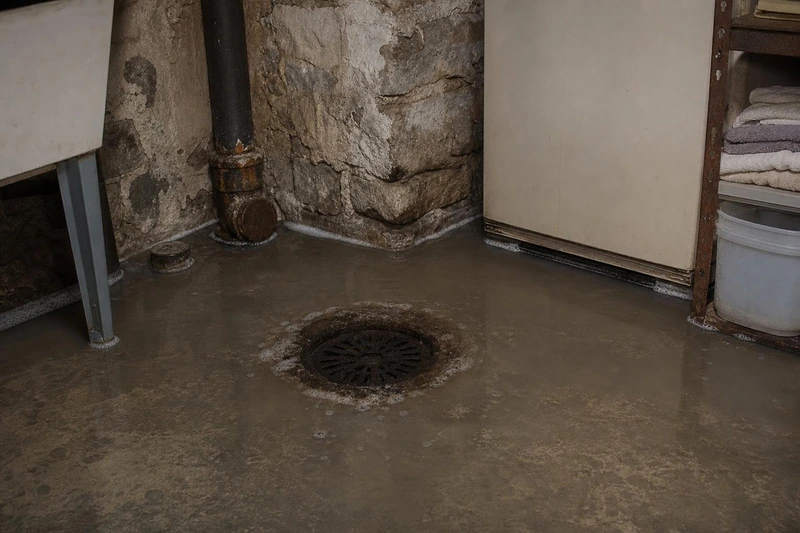
Taking the Standing Water Out of a Bountiful House in the Order That Works
Left until the end, the water held against your baseboards turns a short job into a long one. The open middle of a room gives water up quickly, and the perimeter simply does not. Sequence matters here more than equipment horsepower.
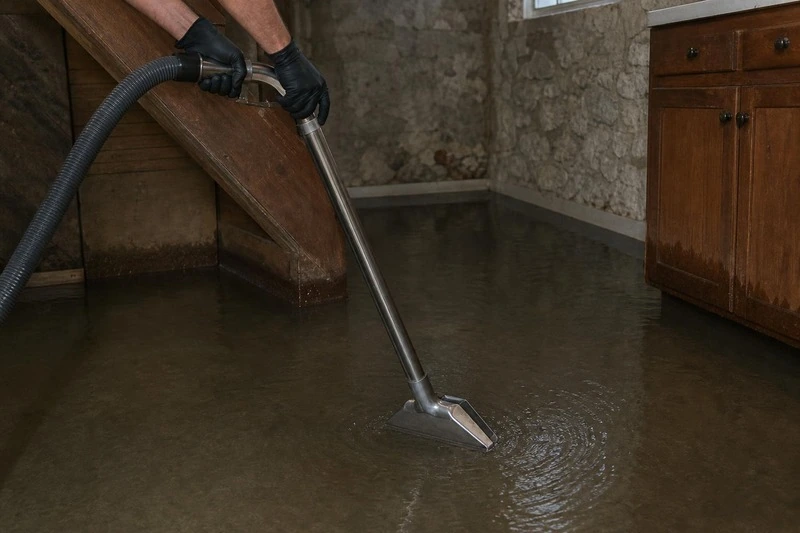
So we plan the wall line as its own task before anyone unrolls a hose. Our truck-mount extractor clears the open floor first, in long overlapping passes, because that is where the volume sits. The wall line then gets a pass of its own, worked slowly with a weighted wand and a water claw.
The field first, then the wall line
Treating those two passes as one job leaves the last band wet. A wand still moving at field speed skims the edge of the room and calls it finished. Water under the pad at the wall needs the head held still, and a hurried pass never gives it that.
The wall line also takes longer than its proportion of the floor suggests. A room can look almost clear and still owe us the majority of the visit.
Where the order goes wrong
The costliest sequence error is drying before extracting. Air movers pushed across a floor that still holds free water shove it sideways beneath the baseboard, into the adjoining room.
The other error is pulling flooring on day one. Once the carpet and pad are gone the slab dries fine, but the wall they were tucked into is still charged. Nobody sees that after the evidence goes in a dumpster.
So the sequence holds: the open floor, then the perimeter band, then the equipment. Every stage runs easier because the stage before it was actually finished.
Call while the water is still down and say how much of the room is carpet. That one answer sizes the perimeter pass.
Anything That Puts Water on the Floor of an Older Bountiful Home
Most of what floods a house here starts inside the house. Bountiful holds 15,332 homes, 10,977 of them single-family detached, and 63.1 percent went up before 1980. The two biggest groups are the 2,856 finished in the 1960s and the 2,829 in the 1950s.
What an older detached house does to itself
Sixty and seventy years is a long service life for a supply line, a tank or a valve. On stock this age the ordinary failures are the ones that fill a basement fastest.
- A supply line that froze and split inside an outside wall.
- A water heater tank nobody has replaced in decades.
- A washing machine hose or a dishwasher line under pressure all day.
- A toilet or fixture that overflows onto the room below.
None of those failures are ours to repair, and the failed component is a separate trade. We take the water out and dry whatever it reached.
What arrives from the roof, the yard and the sewer
The next group arrives from above. Bountiful sits at 4,772 feet, high enough that snow lingers on a shaded roof while the sunny side runs. That difference builds an ice dam, and a roof leak generally follows it.
Heavy snowmelt and storm runoff discover a low door or a window well on their own. The swamp cooler belongs here too, because on stock this age the evaporative cooler often sits on the roof. A unit left charged drops water straight down the interior of a wall.
The final group arrives from underneath. A sewer or drain backup, a sump pump quitting partway through a melt, groundwater seepage at a basement wall. A sprinkler or irrigation backflow delivers it from outside, and all of them finish as standing water.
Bringing a Bountiful Basement Back to Dry After the Last Band Is Gone
Drying is sizing work, and you cannot size a room you have not finished emptying. Position equipment while a wet band remains at the wall and you have sized for the wrong room. That is why the dehumidifiers and air movers come off our truck last.
In a finished Bountiful basement that usually means drying mats over hardwood, lifting moisture up through the boards. We pull the baseboards and put air on the wall behind them. A probe in the bottom plate tells us whether the framing is drying with the floor or lagging.
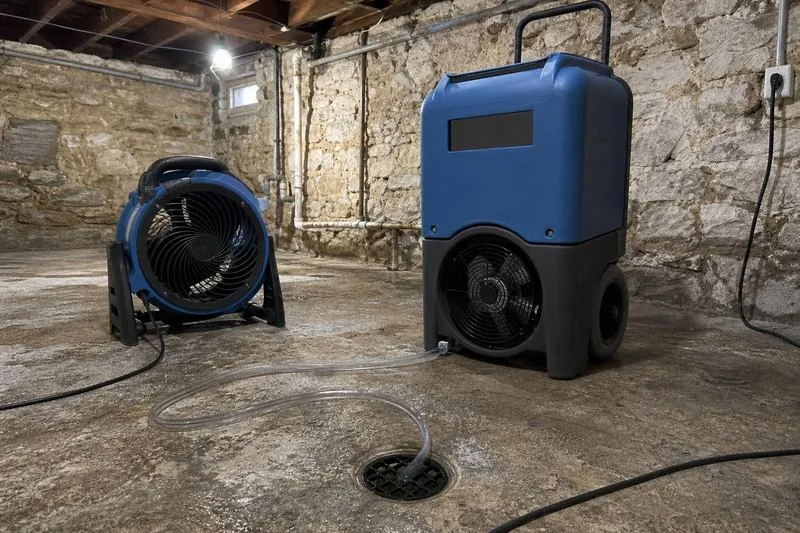
Why the equipment goes in last
Containment goes up when one room must dry on a different schedule, with an air scrubber running inside it. The damp air stays in one place, and the remainder of your home stays usable.
Structural drying is slow by nature, and equipment should never spend its first day undoing a shortened extraction pass.
Baseboard and Carpet Pad Come Off Before We Write Anything Else Off
The same sequence governs what we remove. Baseboard comes off first because it is inexpensive and it dries badly. Taking it off also reveals how far up the wall the water climbed, and we decide nothing larger before that.
Carpet usually survives, and the pad underneath it usually does not. The pad holds water long after the carpet above it has let go.
Sealed vinyl plank over a slab conceals water rather than shedding it, so we lift a corner and look before anyone calls that floor salvageable.
What the water ruins first
If you can move things while you wait, begin with whatever cannot be reordered or replaced. These items stop being salvageable soonest.
- The upright piano standing against a basement wall.
- Paper in the lowest drawer of a filing cabinet.
- Any cabinet with a pressed-board base sitting flat on the floor.
Solid wood and sealed appliances usually recover with time and airflow. A pressed-board core swells from the bottom upward and stays swollen, so lifting it clear beats anything we can do afterward.
Val Verda, Orchard Park, Summerwood and the Rest of Bountiful
We cover both of the city's ZIP codes, 84010 and 84087, everywhere inside Davis County. Val Verda, Orchard Park, Chelsea Cove and Summerwood sit on one rotation, along with every street between them.
Bountiful is not a flat city, and that difference matters when the water arrives. The city figure is 4,772 feet, while Val Verda sits nearer 4,550 and Summerwood nearer 5,379. Snow can be running hard at one address and still frozen solid at another.
When that runoff reaches the street it enters a municipal storm drain system built under a federal permit. The EPA rules for stormwater discharges from municipal sources spell out what such a system is for. It moves water off pavement, and your window well sits outside that responsibility.
Your neighbor's flood rules may not be your flood rules. Federal maps put A, AE, AO and X inside the city limits, and the boundary between two zones can cross one street.
Be Ready Utah, the state household preparedness program, is worth an evening before the next storm. Knowing where your shutoff valve lives is worth more than any equipment we own.
Bountiful gets the order of work we bring to water damage restoration in Salt Lake City itself. Woods Cross and West Bountiful are the two neighbors we reach from here quickest. Check the full list of towns for anything beyond those two.
Water standing in a finished basement turns into a longer job below grade, and the first hour of it goes to pulling the water off the floor. The order is identical either way.
Your Carpet Survives, Your Pad Usually Does Not
Usually not. Carpet itself recovers if the water was clean and the pad underneath comes out early. What ruins carpet is hours on a saturated pad, or water that was already contaminated.
That one belongs to your insurer, and the answer moves with the carrier and the state. Ask your agent what a filing does to your renewal before you decide. We document whatever we find, so the record exists either way.
Worry when the temperature holds below freezing overnight and a supply line runs through an unheated space. Lines in an outside wall, a crawl space or an attached garage are the ones that let go. On stock this old it is usually the line nobody has inspected in decades.
One Number Reaches the Whole Crew
The line rings through to a person at 3 a.m. exactly as it does at noon. Call Water Damage Restoration Salt Lake City and you hear an honest arrival time, not a script.
Book the Slow Last Band In Now
Call and say how much of your floor is carpet running up to a wall. We put the slow perimeter band into the first visit rather than adding it at the end.