
Water Damage Restoration Woods Cross, UT
Are you on carpet that squelches underfoot in Meadow Crossing or anywhere else in Woods Cross? Pick up the phone with that answer and we bring the right extraction head.
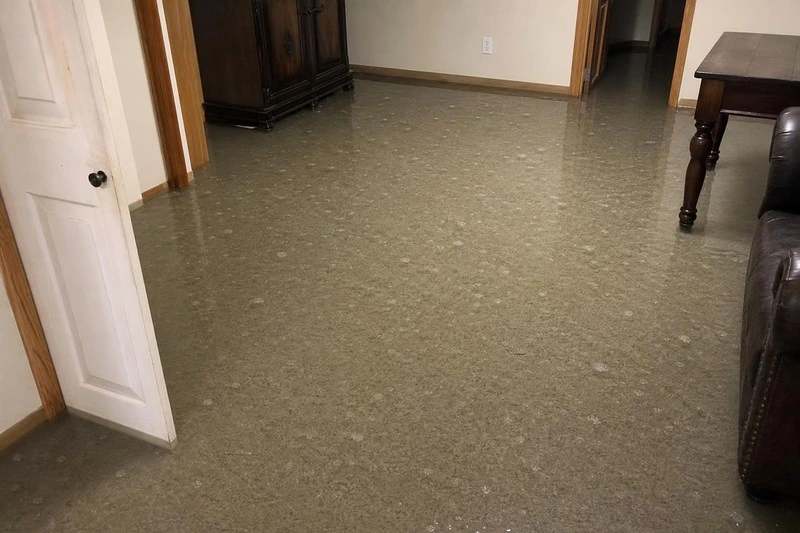
Deciding What Moves First in a Woods Cross House, Then Pulling the Water Out
Carpet moves water sideways in a hurry and then hands nearly all of it down to the pad underneath. Pulling it back out is a reach problem before anything else, since an extractor only takes water from the exact spot it is sitting on.
In a finished basement here, very little of that floor is open. So we start by working out what has to move, and in what order. A sectional couch, a loaded bookcase and a bed frame each cover a patch of soaked pad we cannot touch.
Wood and particleboard drink as fast as the pad does, so a slow move creates a second problem underneath the first. Once the floor is clear we start in the middle of the room and work outward.
A portable extractor rides on the carpet and lifts water through it with vacuum and weight together, pass after slow pass over the same strip. What comes up in those early passes settles whether the pad survives at all. Call us and say how much of that floor has furniture standing on it.
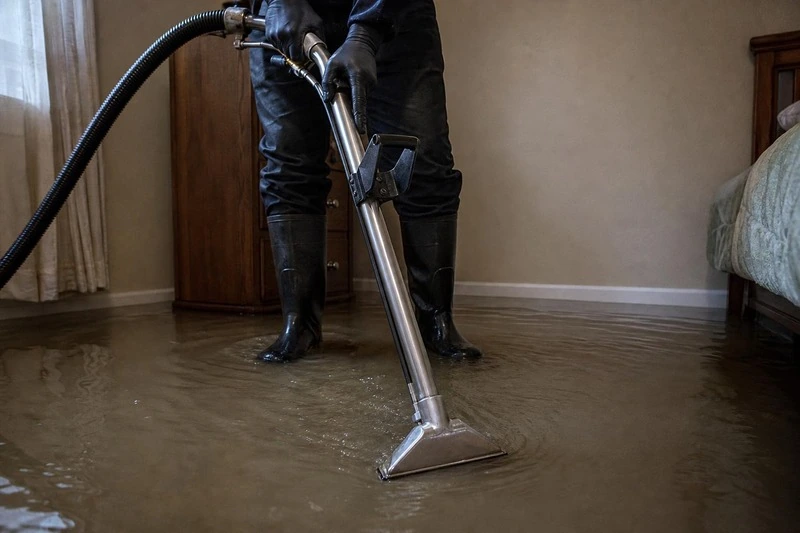
Why the Last Two Feet Are the Hardest
The perimeter is where reach runs out. Carpet is stretched onto tack strip within an inch of the baseboard, and the pad runs right up underneath it.
So the wettest band in the room is also the one an extractor head can barely reach. A closet and the space under a staircase are the same problem in miniature. That is why we would rather pull the carpet back off the strip along one wall.
- Anything on a wood or particleboard base is the first thing we lift onto dry ground, because it wicks fast.
- A door that swells shut becomes a room we cannot get equipment into, so we prop them open early.
- Belongings against the walls sit on the wettest band of pad in the room, which we need clear first.
- A heavy piece nobody can shift goes up on blocks instead of out the door, which buys the reach back.
Outside Taps, Indoor Plumbing and Weather All Put Water on a Woods Cross Floor
Most of what we pump out of this city started in a line inside the walls. A burst or frozen pipe lets go all at once, usually overnight, and a water heater splits along its bottom seam and empties itself.
A washing machine, dishwasher or icemaker supply line fails at a fitting that has held pressure for years. A toilet or fixture overflow does the same job slowly. A sewer or drain backup reverses a line meant to run one direction only.
A sump pump failure is quieter, because the machine keeping that floor dry simply stops. Detached houses on their own lot account for 2,937 of the 3,591 homes here, so nobody upstairs hears the first of it.
The stock is young for Davis County, where 1,084 of them date from the 2000s and another 586 from the 2010s. Only 32.1 percent went up before 1980.
Newer plumbing fails less often, but it fails behind finished drywall somebody already spent money on. Outside the walls, sprinkler and irrigation backflow pushes lawn water back through a hose bib or valve box and into a window well.
The Environmental Protection Agency publishes WaterSense guidance for outdoor water use. It is a fair place to read how those systems should be set up.
A swamp cooler leaks the same way most summers. The water runs down inside a wall from the line feeding the evaporative cooler above. Basement seepage and groundwater come in lower, at the seam where the slab meets the wall.
Weather delivers the last three. Snowmelt and storm runoff pond against a foundation when the ground is frozen, which is the drainage problem the stormwater division of Woods Cross City public works describes.
An ice dam backs meltwater under the shingles until it finds a ceiling. Rain finds that ceiling too, whenever a roof has already given up somewhere above it.
Pads Hold Water Longer Than Carpet, so Drying Runs on Their Clock
Carpet fibers give up their water quickly once the extractor has finished. The pad does not, because it is a foam sponge with a plastic film on one face. Everything it holds has to travel back up through the carpet to leave.
Air movers do the moving. They are low fans aimed along the floor at a shallow angle, chained around the room so the air keeps traveling one way instead of swirling.
A dehumidifier in the middle of the room strips that moisture out before it lands somewhere new.
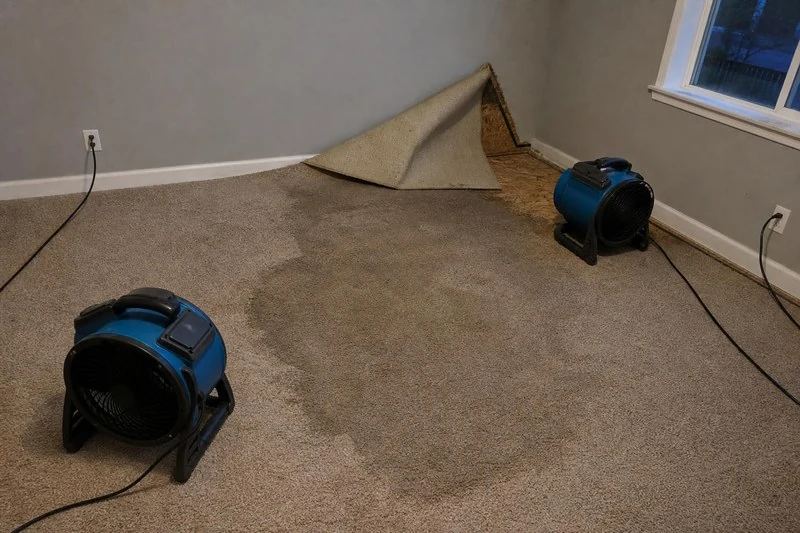
What Happens to the Wall Before the Fans Go In
Water that climbed into the drywall has no interest in how the room looks. We take the baseboard off first and check the bottom inches with a moisture meter. Then we drill small weep holes low in the sheet so the wall cavity can vent.
Skip that and the wet side of the drywall stays sealed behind paint. The fans dry the part of the room everybody can see and leave the part nobody can.
Tack Strip Comes Up First, and Then We Sort What Stays
The pad usually loses. Once saturated and walked across it flattens, separates and stops springing back, and moving air cannot rescue a layer that has gone to mush.
Carpet does better, provided it came off the strip early and dried from both faces. Tack strip is cheap and it rusts, so we pull it rather than argue over it.
What was standing on the carpet is the longer conversation.
- Solid wood furniture is usually worth drying slowly instead of hauling away, if it left the wet floor the same day.
- Particleboard and laminate cabinets are the first things to swell past saving, because the core drinks and never recovers.
- A stamp album, or anything else irreplaceable, we carry to dry ground before we set a single fan.
- Books, paper and upholstery are salvageable for a shorter window than people expect, so we sort them early.
- Anything the water reached after leaving a drain is treated as contaminated and not kept, whatever it cost.
Meadow Crossing and Every Other Street We Reach in Woods Cross
One ZIP code, 84087, covers all of Woods Cross, from Meadow Crossing out to the Bountiful city line. We work about 9.7 miles from the nearest edge of town, so the extractor spends its time on your floor rather than in traffic.
The city sits at 4,249 feet and Meadow Crossing barely differs at 4,251. No side of town quietly stays dry. The only flood hazard area mapped inside the city limits is Zone AE and nothing else, which says nothing about a line letting go in a finished basement.
Where Else We Go from Here
The rest of what we handle sits on our main water damage restoration page for Salt Lake City. We keep the whole roster of cities on one page. The carpet and pad work runs on into North Salt Lake, Centerville and Farmington.
If the water is still coming in, start with a hose and an extractor, because the pad decision waits until the source stops. A basement that took it through the wall belongs with the below-grade work.
Rented Cleaners Cannot Pull a Saturated Pad
The bill tracks the size of the wet area, measured in square feet of pad rather than in rooms. Hours matter next, because water with a full day to travel gets under walls and into cabinet bases. Whether it stayed clean decides the rest.
You can take standing water off a hard floor with a wet vacuum. Lifting soaked belongings onto dry ground helps too. Carpet is where do-it-yourself runs out of road, because a rented cleaner rinses fibers without the vacuum to pull a saturated pad.
Stick to what you saw and when: the hour the water appeared, the rooms it reached, and what has already left the building. Photograph the wet floor and wall before anything shifts, and keep the pad and trim you pulled.
One Number Reaches the Whole Crew
The line rings through to a person at 3 a.m. exactly as it does at noon. Call Water Damage Restoration Salt Lake City and you hear an honest arrival time, not a script.
The Pad Under Your Carpet, and What It Is Holding
Our first move is under the carpet, because the pad is holding the water and the carpet only carries it. We need the room size and how long it has been wet, and somebody picks up this line at night.