
Water Damage Restoration Layton UT
A portable extractor runs on a finite suction budget, and the hose length plus every foot of lift spends it, so we measure the run before switching anything on. Call and we shorten it first.
How Much Water One Hose Run Can Pull Out
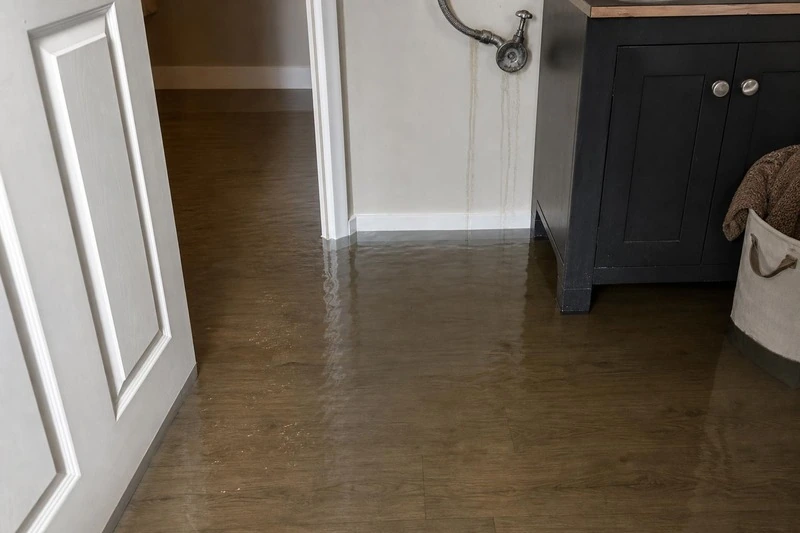
Is there water standing on your floor right now, and are you wondering why the shop vacuum barely moves it? The answer is capacity. Every machine that pulls water has a ceiling, and your layout decides where that ceiling sits.
A portable extractor works by suction, and suction is a finite budget. It is spent on the hose between the unit and the water, and spent again on every foot the water travels upward.
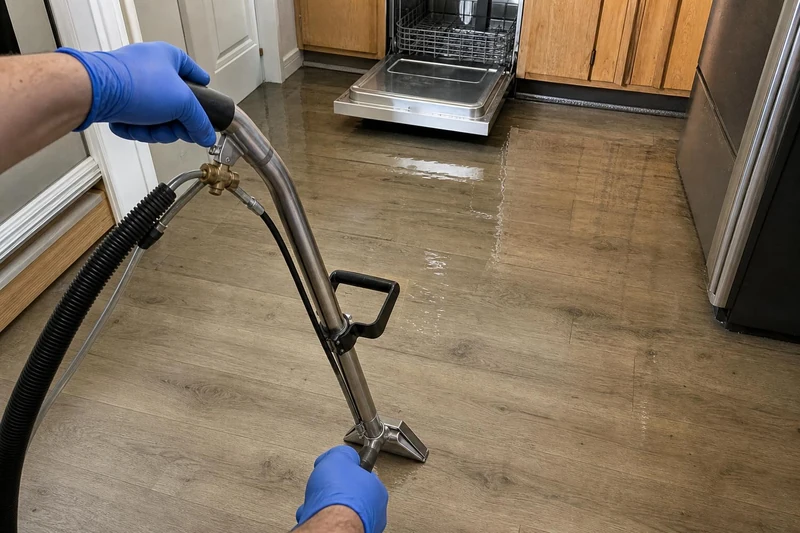
So the first thing we do in a Layton basement is measure the run, not switch anything on. A short flat run pulls a floor in one pass, and the same floor at the top of a stairwell takes three. We shorten it first, usually by carrying the unit down to the wet floor rather than the driveway.
Why the run length decides what the machine pulls
Suction lifts water, it never pushes it. Lift is the expensive part, and you do not get it back once it is spent.
Put a flight of stairs between the wet floor and the unit and the pull per pass drops hard. The machine takes less water each time the wand crosses the same square foot.
Distance costs less than height, and it still costs. A hose strung the length of a basement and bent around two corners will not empty a room the way a short line does.
The wand, the squeegee and the last quarter inch
The extraction wand is the head on that hose, and its own weight presses water back up out of carpet and pad. A water claw does the same on a glued down floor.
What a wand cannot do is chase water across an open room. That is the squeegee's job, walking it out of corners and low spots to the wand.
The Whole List of What Puts Water on a Layton Floor
What we ask on the phone is where the water sits relative to the nearest door at grade. Here is the full set of causes, weighted the way this city is built.
What Layton's housing stock makes likely
Layton holds 28,497 housing units and 69.5% of them are single-family detached houses. Owner-occupancy runs 71.6%, and only 27.3% of the stock went up before 1980.
That mix points at indoor plumbing far more often than anything from outside. It also leaves a quarter of the city old enough to carry equipment nobody puts in new builds.
- Supply plumbing and appliances, easily the biggest group here: a burst or frozen pipe, a water heater failure, a washing machine, dishwasher or appliance supply line, and a toilet or fixture overflow.
- Drains running backward, meaning a sewer or drain backup and a sump pump failure, which fill a finished basement before anyone upstairs notices.
- Water arriving from above, which is snowmelt and storm runoff, an ice dam pushing melt under the shingles, and a plain roof leak.
- Basement seepage or groundwater, the below grade route, where saturated ground finds a way through and quiets down once it drains.
- Seasonal outdoor equipment, sprinkler or irrigation backflow in summer and a swamp cooler leak on older houses still running an evaporative cooler.
Only that middle group has a season. The National Weather Service flood safety guidance covers how fast melt and heavy rain turn into moving water.
Drying a Layton House After the Extractor Stops
Extraction takes the water you can see. Drying takes the water that soaked into drywall, baseboard, subfloor and framing while the floor was still under it.
Those are two machines on two clocks. Treating them as one job is how a room that seemed handled comes apart later.
Air movers and dehumidifiers do different jobs
Air movers push a fast flat stream across wet surfaces so the moisture lifts into the room. On their own they only relocate the problem.
The dehumidifier strips that moisture back out of the air and drains it away as liquid. Run the pair in a closed room and the structure gives up water it would never surrender to an open window.
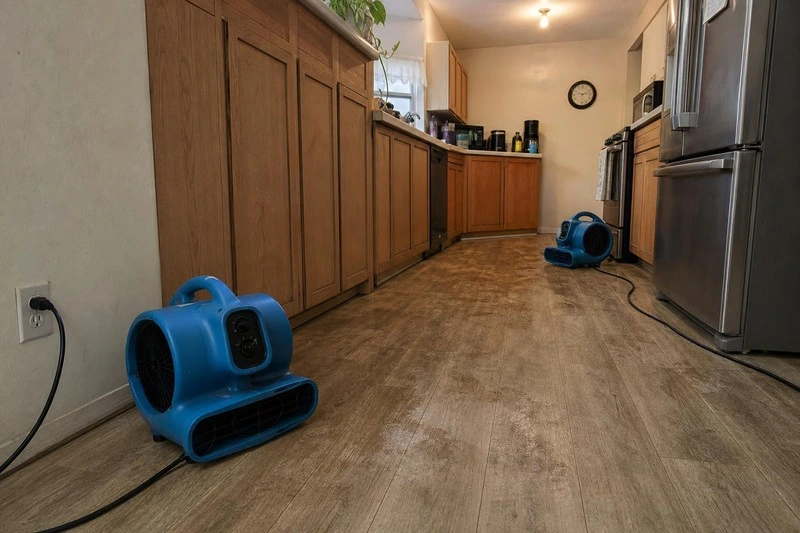
We track progress with a moisture meter, not by hand, and the equipment stays until the numbers stop falling. Structural drying finishes on evidence, not a calendar.
What Survives a Soaking in Layton
Most of a house survives water when the water leaves fast. What does not survive is anything built to hold liquid that cannot be opened and aired.
Carpet is often salvageable once the pad beneath it is replaced. Pad is not, because it stores water by design and it stores contaminated water as happily as clean.
The things we get off the floor first
Before the wand comes out we lift whatever cannot be bought again.
- Anything with paper inside it, from a file of tax records to a boxed stamp collection, because paper draws water upward faster than anything in the room.
- Instruments and electronics sitting low, usually fine if they come up right away and rarely fine after a night on a wet floor.
- Soft furniture standing in it, since a wet couch leg wicks upward and marks a frame that would otherwise have dried out clean.
We judge drywall and baseboard on how far the water climbed behind them. Where it climbed, the finish comes off so the framing can dry.
Covering East Layton, Kays Creek and the Rest of the City
Layton runs on two ZIP codes, 84040 and 84041, and both belong to this city alone. East Layton and Kays Creek sit inside 84040.
Height is the local detail that changes what a machine can do. The city figure is 4,458 feet, East Layton sits at 4,563 feet, and Kays Creek at 4,906 feet.
Ground that falls away often puts a door at grade near the wet room. A level entry takes a whole flight of lift out of the run, so we ask early. We come at Layton from the south, so tell us on the call which end of the city you are on.
What the flood record says about these two ZIP codes
Because Layton holds both ZIP codes outright, the federal claim record describes this city and no neighbor. ZIP 84040 carries 9 paid claims under the National Flood Insurance Program and 84041 carries 12.
The amounts are modest for a city this size: $5,687.74 paid across 84040 and $3,800.46 across 84041, with dates of loss running from 1982 through 2025.
Layton records Zone A, Zone AE, Zone AO and Zone X on the federal flood maps. The Utah Division of Emergency Management handles flood mitigation across Davis County. None of that speaks to a supply line in your laundry room.
We reach Layton from the yard we work out of in Salt Lake City, and the city sits inside the footprint on the areas we cover. Most calls open as emergency water removal, and water that came up through the floor turns it into a basement clear-out.
Coming up the valley the run passes Farmington, Fruit Heights and Kaysville before this city.
Dehumidifiers Are the Wrong Machine While Water Is Down
A dehumidifier pulls moisture out of air, so it is the wrong machine while water is still lying on the floor. It will spend the whole night on a problem it cannot reach.
It is also wasted in a room left open to the outdoors. Extract first, then close the space up.
An attic dries from the top down, and only once water has stopped arriving. Soaked insulation comes out rather than staying in the bay, because it holds water against the framing long after the rest feels fine.
The framing and the ceiling beneath it then get airflow and monitoring until they hold steady. New material goes back last, since replacing it early traps the water.
On wet drywall, wood and insulation, growth can begin inside a day or two, and the water sitting out of sight is what feeds it. That window is why standing water should come up the same day.
We do not judge that ourselves. Anything mold related starts with an independent report from a separate party.
One Number Reaches the Whole Crew
The line rings through to a person at 3 a.m. exactly as it does at noon. Call Water Damage Restoration Salt Lake City and you hear an honest arrival time, not a script.
How Far Is the Water From the Door?
What sits between the wet floor and the nearest door at grade? We carry the unit down to the water rather than working it from the driveway.