
Water Damage Restoration Draper, UT
What sits lower, the water on your floor or the nearest drain? In SunCrest basements it is usually the water, so it has to be pushed uphill to get out, and every foot of that climb costs suction and time. Call and we size the pump before we roll.
Every hour that standing water sits on a floor spends something you do not get back. The wet keeps working into framing, subfloor and cabinet bottoms, and what can still be saved shrinks the whole time.
In a Draper basement that matters more than usual, because the floor is the lowest point in the house and the nearest drain sits above the water. Water leaves a room like that only when something lifts it, and lifting is slow.
Before we roll a truck, we want two answers from you. How deep is the water, and how far does it sit below the nearest drain or door? Call and give us those two answers, because picking the pump right on the phone saves the first half hour.
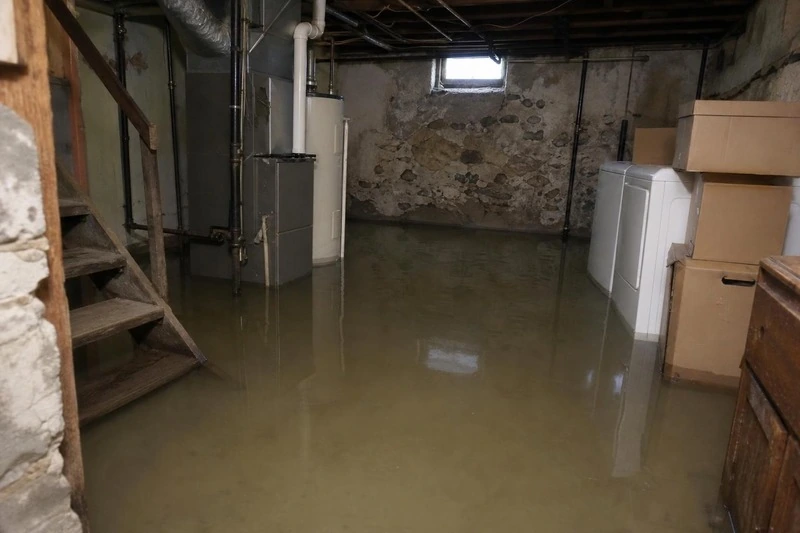
Lifting Is Why Pumping Water Out of a Draper Basement Takes Longer
A pump does not move a fixed amount of water per minute. It moves less the higher it has to push, so equipment chosen for flow rate on a flat run crawls once the hose turns up a stairwell.
We size the equipment for the climb first and the volume second, and we settle the discharge route before anything switches on. Moving a running line halfway through puts water back in the room we just cleared.
The bulk of the water comes up through a portable extractor, with a squeegee working the shallow film out of the corners toward the wand. Suction lifts the sheet on the surface, but not what has soaked into the pad and the base plate.
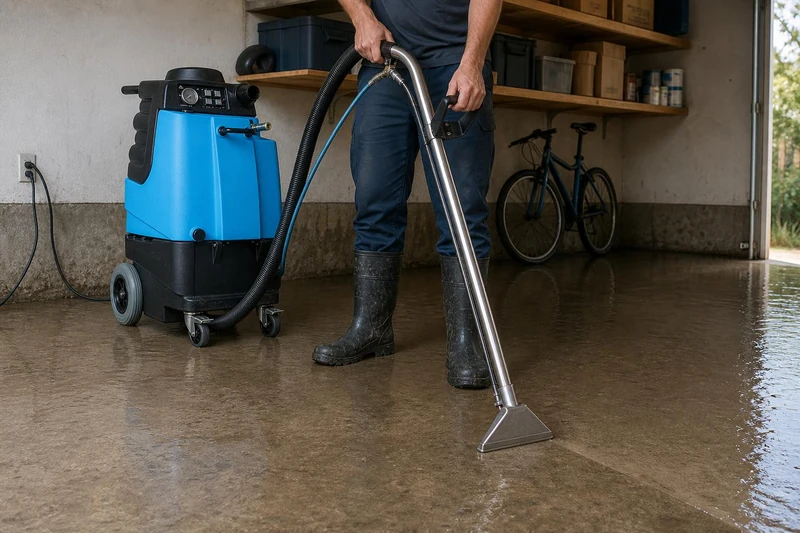
Why we settle the discharge route first
Where the water ends up matters as much as how fast it leaves. It has to discharge somewhere that will not feed back through a window well or a neighbor's driveway.
What the early hours actually buy
Early on, almost everything in the room is a drying problem, and given long enough the same materials turn into a demolition problem. Nobody picks which of those two jobs they get, because elapsed time picks it.
Every Failure That Puts Water on a Draper Floor
Draper is young housing. Only 5.2% of its homes were finished before 1980, and 62.8% of the stock is single-family detached.
Newer does not mean drier. A newer detached house carries more fixtures, more appliances and more feet of supply line, and every connection in that count is somewhere water can leave the system.
Sorting the failures by the height they start at
Draper climbs hard: the city center sits at 4,666 feet while SunCrest sits at 6,080. A good share of the water here arrives from ground higher than the house it ends up in. The city's own storm water and drainage pages set out how that runoff is meant to leave the streets.
Above the ceiling, an ice dam holds meltwater on the roof until it works back beneath the shingles. A plain roof leak lets water through whenever the covering wears out. A roof-mounted evaporative cooler, the swamp cooler kind, drips straight down through the ceiling below it. Those are uncommon on stock this new, though the older share of the city still runs some. Snowmelt and storm runoff belong up here too, starting on ground well above the house.
At the level you are standing on, more of them let go. A pipe bursts, often after freezing in an unheated garage wall or a crawl space. The tank on a water heater opens at its base and empties where it stands. Behind a cabinet, a hose to the washer or the dishwasher lets go unheard. A toilet or fixture overflow keeps overflowing with nobody home, and a sprinkler or irrigation backflow drives yard water the wrong way through the wall.
Beneath the slab sit the ones that arrive dirty. A sewer line runs backward and surfaces at the deepest drain. A sump pump quits on the single night it was bought for. Basement seepage and groundwater come through the slab and the bottom of the walls once the hillside above has taken on more than it can hold.
Air Takes Over Where the Pump Stops in a Draper Home
Once the standing water is gone, what remains is inside the materials. Framing, subfloor, insulation and drywall paper all hold water that suction cannot reach, so the rest of the job belongs to air, heat and patience.
Structural drying means pushing dry air across wet surfaces, then pulling that moisture out before it settles somewhere new. Air movers do the first half and dehumidifiers the second, and both run without a break, because equipment switched off overnight hands the moisture a whole night to redistribute itself.
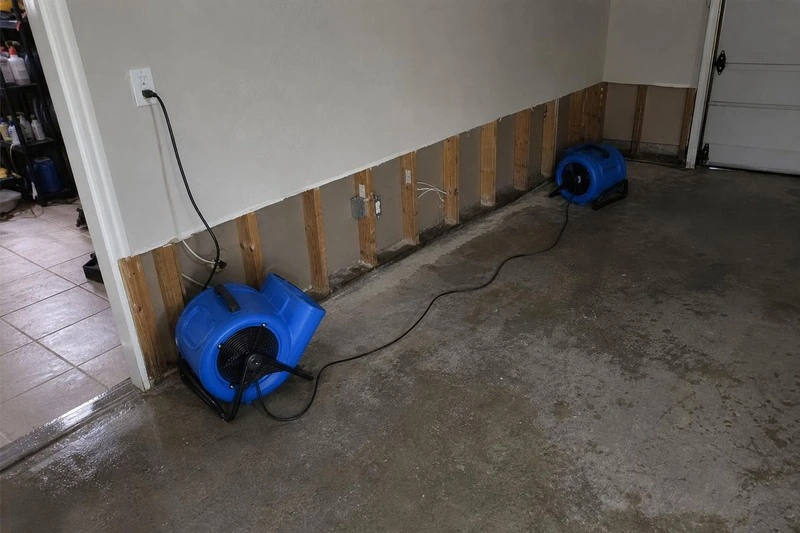
Where the air has to reach
The hard places are the ones air never enters on its own: under a floating floor, behind a bath panel, inside a wall cavity. We find them with a thermal camera, because wet material sits at a different surface temperature than the dry material beside it.
When a room has taken sewage, containment goes up before the drying starts. A scrubber then filters the air inside that enclosure, so the fans do not spread the problem.
Saved or Cut Out Depends on How Long It Sat
Materials surrender on their own schedules, and solid wood and framing usually dry out and come back. Carpet pad, particle board and wet insulation mostly do not, and drywall paper gives up before the gypsum behind it.
Elapsed time settles which is which. The same soaked baseboard is a drying job in the morning and a demolition job two days later. The cost of waiting is not a bigger bill for the same work, it is different work.
If you can do one thing before we arrive, lift the irreplaceable things clear of the floor. A wedding dress in its bag, a box of medals and discharge papers.
That first stretch is a job of its own, and our page on getting the water out fast covers it. When the whole lower level has gone under, read what we do with a basement full of water instead.
SunCrest, South Mountain and Every Draper Address in 84020
One ZIP covers the whole city, so any address ending in 84020 is inside our area. That takes in SunCrest on the ridge at 6,080 feet and South Mountain at 4,938.
Nobody else uses 84020, so the numbers below belong to Draper alone. Twelve payouts have come out of the federal flood program for this ZIP, a city of 16,865 housing units. The oldest loss dates to 1985 and the newest to 2023.
That is a small number, and it matches what comes through the phone. Most water damage here begins with a fitting, a tank or a hose.
The federal maps are not blank here, though. A floodway runs inside the AE zone, and A, AO and X cover other parts of the city.
Runoff on ground this steep is partly forecastable, and the NOAA National Water Prediction Service publishes the federal streamflow and runoff outlooks. One city over, Bluffdale, Riverton and Sandy hand a pump the identical climb.
Salt Lake County is the whole of our water damage restoration map. Not sure whether your street is on it? The service areas page will tell you.
Two Days to Mold, and a Ceiling That May Stay
Growth can begin inside a day or two when the material stays wet and the room stays warm. Drywall paper is an easy food source. Nothing here is a mold assessment, and if mold is the real question, an independent assessment should come first.
Not always. A ceiling that got wet once and dried fast often stays, especially if the board never sagged. A ceiling that held water long enough to bow, stain through or soften at the seams is coming down.
A leak comes from a pipe, a fitting or an appliance inside the building. It stops when that thing is shut off or repaired. Seepage comes through the structure itself from wet ground outside, and it stops when the ground drains.
A leak has an off switch, and seepage has a schedule. Either way, the standing water still has to be lifted out.
One Number Reaches the Whole Crew
The line rings through to a person at 3 a.m. exactly as it does at noon. Call Water Damage Restoration Salt Lake City and you hear an honest arrival time, not a script.
Which Way Does the Water Have to Leave?
Turn off whatever is still feeding the room, then tell us how far the water sits below the nearest drain. We load for that climb, and someone picks the phone up at any hour.