
Water Damage Restoration Riverton, UT
Shut off the source if you can reach the valve, then leave the floor exactly as it is. Nothing lifts up through the seams of a floating floor. Reach us before anything comes up.
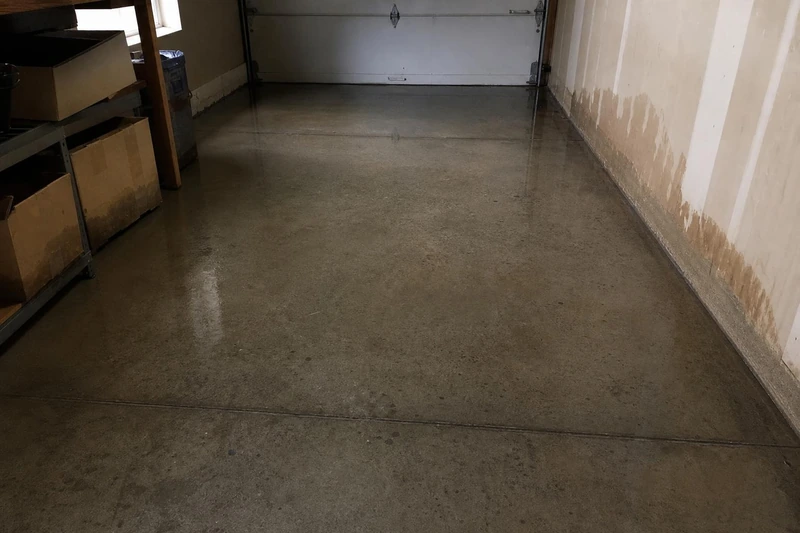
Removing Water From Under a Riverton Plank Floor
Nobody should be reading an insurance policy while water stands on the floor. We hear the same worry on most Riverton calls. The caller has already decided the claim will be turned down.
We will not tell you what your insurer is going to pay, because that decision is not ours. What we can tell you is that the water keeps moving while anyone reads the fine print, so the first thing we settle is not paperwork.
It is whether we can reach the water at all, and the floor covering usually decides that. A click-together plank floor rides on thin foam underlayment and behaves like a sealed lid. Nothing lifts up through those seams, so a wand run over the top pulls out almost nothing.
What has to move before the water can come out
Reach is the whole problem on this kind of floor. We lift the plank at the wall line and work it back in rows, and the foam comes away with it. Extraction then lands on the slab, where the water actually sits.
We make that call before a single hose runs, because the order of those two steps decides how much of the room survives. A few ordinary things decide how fast we get to it.
- Furniture along the wall line moves first, because the plank comes up from the edge.
- A stair landing or fixed cabinet run pins the floor and forces a longer route.
- Storage stacked around the perimeter hides the exact edge we need to lift.
- A door threshold tells us where one floor stops and the next one begins.
Why the pump comes in before the extractor
When the water is deep enough to stand in, a submersible pump clears it faster than any extractor, and it runs while the plank is still coming up. Once the depth drops too low for a pump, extraction takes over on the bare slab.
Riverton basements tend to be large and squared off, so the run to a floor drain is usually short.
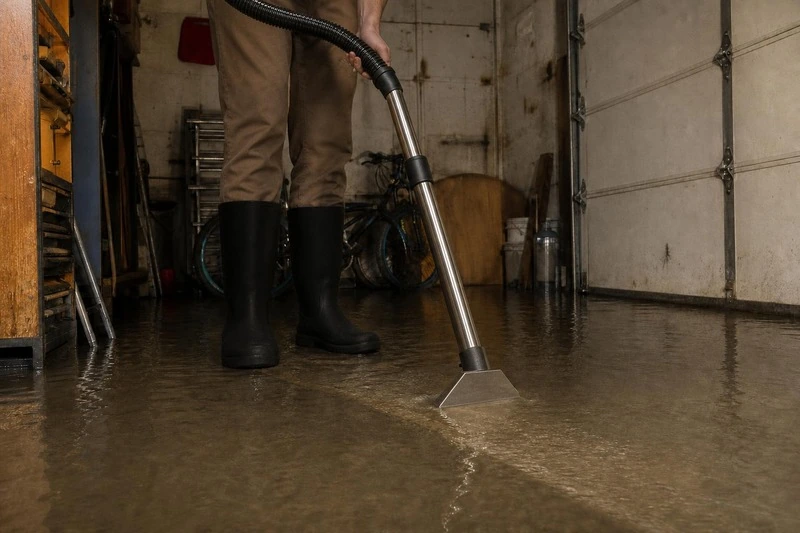
Whether It Came Through a Fitting, the Roof, or the Ground
Riverton's housing is young, and that shifts which failures turn up here. Of the 14,050 housing units in the city, 4,357 date from the 2000s and another 3,969 from the 1990s.
Through a fitting inside the house
Most of our Riverton work starts here. A burst pipe, a frozen line in an unheated corner, or a water heater that opens at the seam will empty into a basement. So will a washing machine or dishwasher supply line, a toilet or fixture overflow, or a failed sprinkler backflow assembly.
A sewer or drain backup belongs here too, though it surfaces wherever the basement plumbing sits deepest and arrives dirty. On a house from the 2000s, the tanks and braided appliance connectors have aged out first, not the copper.
Through the roof
A roof leak, an ice dam and a swamp cooler leak all arrive from above. They land in the same places: the ceiling, the top plate, then straight down inside the framing. Only 13.1% of Riverton's stock predates 1980, and that older slice is where roof-mounted evaporative coolers still live.
Through the ground
Snowmelt, storm runoff, basement seepage and a sump pump that quit all arrive from outside and below. The federal flood maps put three zones inside Riverton's boundary, A, AE and X, so exposure is not the same street to street. Salt Lake County Public Works and Municipal Services maintains the county storm drains and flood channels that carry a fast melt away.
Not all of that water comes over the top of the soil. Some rises through the ground itself, and the Environmental Protection Agency's overview of ground water and drinking water describes how it travels down there. When a storm pushes some of it inside and then stops, what got in is what we pull back out.
Underlayment Foam Dries Last and Sets the Whole Schedule
Once the standing water is gone, the foam and the slab still hold the last of it. That is what sets the length of the job. Foam gives water up slowly, concrete slower still, so we aim the drying at those two surfaces rather than the room air.
Where we set the air movers and dehumidifiers
Air movers sit low and angled along the open slab. The moving air peels water off the surface instead of sailing over the top of it. A dehumidifier handles the rest, holding the room's humidity down so the slab keeps releasing.
We shift both as the job changes rather than setting them once and walking off. Walls need their own route, so where water wicked up the drywall the baseboard comes off and weep holes go in low for cavity drying behind the sheet.
In the carpeted rooms next to the plank, a carpet lift with the pad pulled out beats drying a soaked pad in place.
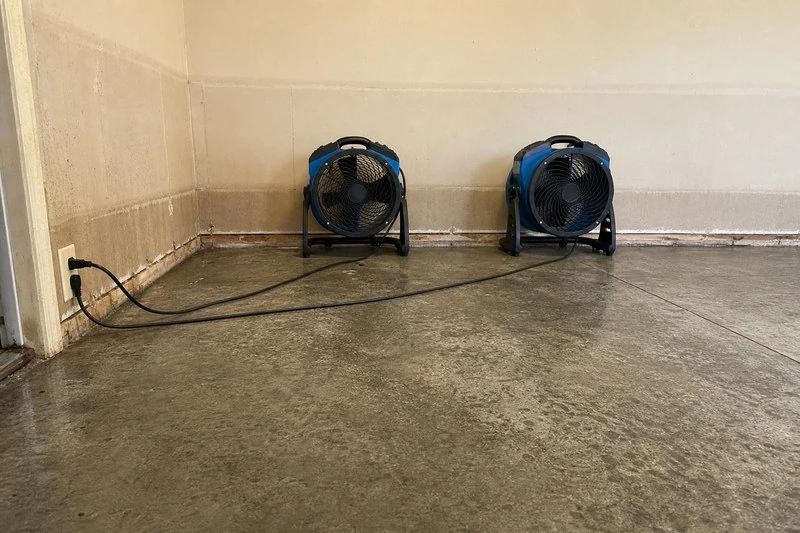
Plank, Foam, and What Stays in a Riverton Basement
Plank rarely goes back down, because click-together boards swell at the edges once they have been wet and lifted, and the locking profile stops holding. The foam beneath is cheap and leaves with the plank.
The harder calls are sitting on top of the floor. A grandfather clock standing flat on the plank has been drinking since the first hour, and nobody is willing to lose it. We lift anything solid wood that touches the floor onto blocks early.
Roughly how the rest of it falls in a finished basement here.
- We cut the drywall back above the waterline wherever it stayed wet along the bottom edge.
- Batt insulation behind that cut comes out, because it holds water long after the framing lets go.
- Solid wood furniture usually survives if it gets off the floor early enough.
- Particle board and pressed panel almost never survive, however carefully the room is dried.
None of that is a coverage decision and we do not treat it like one. We record what came out, what we cut, and the reason for each, and that record goes wherever your claim needs it.
Midas Crossing, Rose Creek Crossing, and the Rest of Riverton
Riverton fits inside 84065 top to bottom, so we never ask which side of a line you are on. Midas Crossing sits at the north end near 4,494 feet, Rose Creek Crossing at the south end near 4,578 feet, and the city as a whole averages 4,543 feet.
Owner-occupancy runs 87.2% here, and 80.5% of the structures are detached single-family. That is a city of basements with finished space in them, which is why the plank floor question comes up so often.
We move fastest on a straight water pull, and a basement job runs that from the stairs down.
We work Herriman to the west, Draper to the east and West Jordan to the north, and one page carries every other city on the run. The same equipment handles water damage restoration across the Salt Lake City area, whatever your address.
Tell us how long the water has been under there and what the floor is made of. That is enough for us to know what has to come up first.
Soaked Pad Grows Mold Before the Room Smells
Fast enough that it changes the order of work, because a soaked pad holds water flat against the floor and shuts off the air underneath. Growth can begin within a couple of days in a warm room, which is why the pad comes out early.
Not on its own, no. But that smell means some material below is wet and has stayed wet. The candidates are a carpet pad, foam underlayment, the bottom edge of the drywall, or the framing behind it.
Losing power during the same storm that made the pump necessary. The equipment is fine and the outlet is dead, so the basin fills anyway. Age and a stuck float cover most of the rest. The water that came in while it was down is our part.
One Number Reaches the Whole Crew
The line rings through to a person at 3 a.m. exactly as it does at noon. Call Water Damage Restoration Salt Lake City and you hear an honest arrival time, not a script.
The Planks Come Up Before the Water Does
A floating floor changes where we start, so we settle that before anyone touches a plank. How long has water been sitting under there?