
Water Damage Restoration North Salt Lake, UT
Turn the main off if you can reach it without wading. Engineered plank gives out at the glue line under the veneer, well before the board shows a thing. Call while it still looks fine.
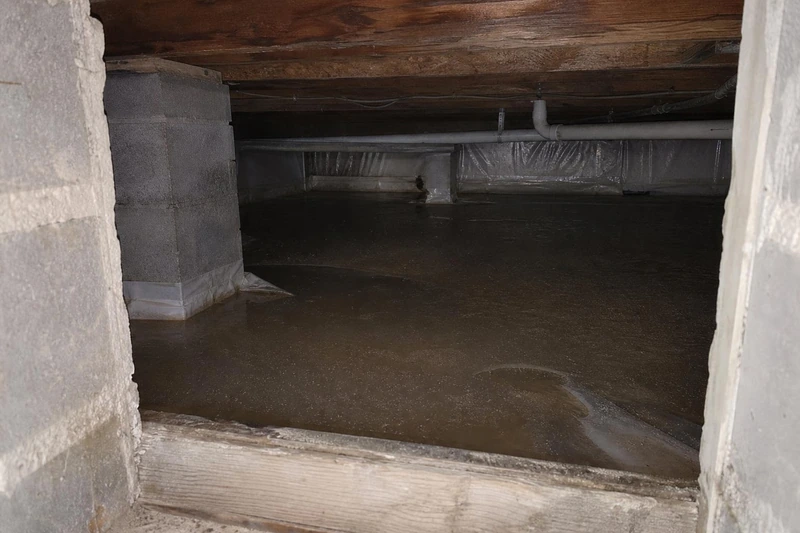
Getting the Water Out While the Floor Can Still Be Saved
Standing water has to leave the room before anything else can be decided. That is true whatever put it there, so we pull it out first.
Most of this work does not care how long the water sat. A wet vac moves the same volume on hour two as on hour forty.
Where this usually starts: water leaves a line, a tank, an appliance, a fixture, a drain, or the weather outside, then runs to the lowest finished floor and spreads flat across it. That floor is where we start, whatever opened upstream.
What elapsed time changes is the list of choices still open to you. Some close quietly while the water sits there, and no equipment reopens them.
Much of the housing here is floored in thin engineered plank, a veneer of real wood glued onto a core board. Over a slab, that floor sends water one direction only, sideways along the seams.
The glue line under the veneer gives out first, and the trade word for it is delaminating. It happens before the board shows a thing, so waiting for a floor to look bad means waiting too long.
So the surface comes clear first. A wet vac takes the standing water off the plank in overlapping passes, starting at the low corner.
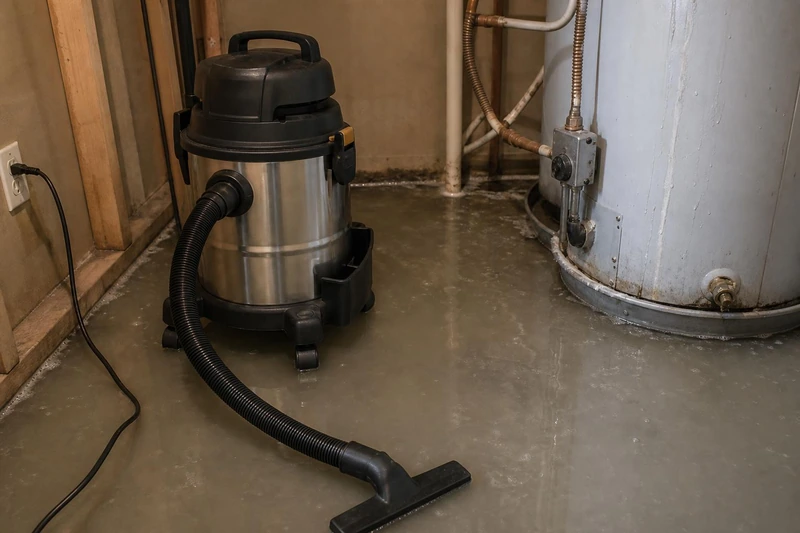
With the surface clear, we read the plank edges and the wall joints, not the middle of a board. An infrared camera traces where the water traveled underneath.
Why we clear the water before we survey
Surveying a room while the water is still moving measures a problem that keeps changing. We clear, then we measure, and the second look is the one worth having.
The decision that expires
Early on, saving the floor in place is a real option. Later it stops being one, and the change happens without any announcement.
Over a slab it arrives sooner, because the water travels sideways instead of draining down. Once a lifted board shows an open glue line, the floor comes up.
So the first thing we want on the phone is when the water started, not when you found it. That answer tells us how much room is left.
- We confirm the source is shut down, so nothing keeps feeding the room.
- We take the water off the surface with a wet vac before we touch anything else.
- We lift one board at the wettest seam and look at the glue line.
- We take readings at the plank edges, the walls, and the doorways.
- We run thermal imaging across the floor and lower walls to trace where the water went.
- We open base trim and drywall only where the readings and the camera agree.
What Starts a Water Loss in North Salt Lake
We take these calls whatever let go, in Foxboro and everywhere else inside the city.
What changes from one city to the next is the mix. Here it follows what North Salt Lake built and when, and most of it went up in the past twenty-five years.
Which of these we see most here
Of the 8,086 housing units here, 2,726 were finished between 2000 and 2009 and another 1,736 between 2010 and 2019. Detached houses are 60.5% of the stock, most with a finished basement.
In houses that age the openings are nearly always indoors. A water heater that splits at the tank, a burst or frozen pipe on an outside wall, an appliance supply line behind a washing machine or dishwasher, and a toilet or fixture overflow a floor up cover most of what we get.
The drain side accounts for much of the rest. A sump pump failure lets a pit fill and spill across a finished floor, and a sewer or drain backup pushes water up through the lowest fixture in the house.
Outside water is the other half of the year. An ice dam backs water under shingles into a ceiling, a roof leak drops it into an upstairs room, and snowmelt and storm runoff finds a window well or a door threshold.
Basement seepage and groundwater belong on the same list, pushing in low through the foundation after a long wet stretch. What may leave a property, and where the city expects it to go, is set out in North Salt Lake's own stormwater management rules.
A sprinkler or irrigation backflow runs on the calendar instead, sending water back toward the house at spring startup when a valve fails.
Roughly a quarter of the housing here was finished before 1980, and 1,073 of those units date from the seventies. Those are the houses still running an evaporative cooler, where a swamp cooler leak drips through a ceiling for weeks before anybody looks up.
Drying an Engineered Floor Before the Glue Line Goes
Once the standing water is gone, the building still holds what it absorbed. Drying decides whether we are out in days or still here in two weeks.
Drying mats seal down onto the plank and pull water back up through the seams, with hoses running to a dehumidifier in the nearest hallway. Air movers push air across the wet surfaces so the machine has something to take.
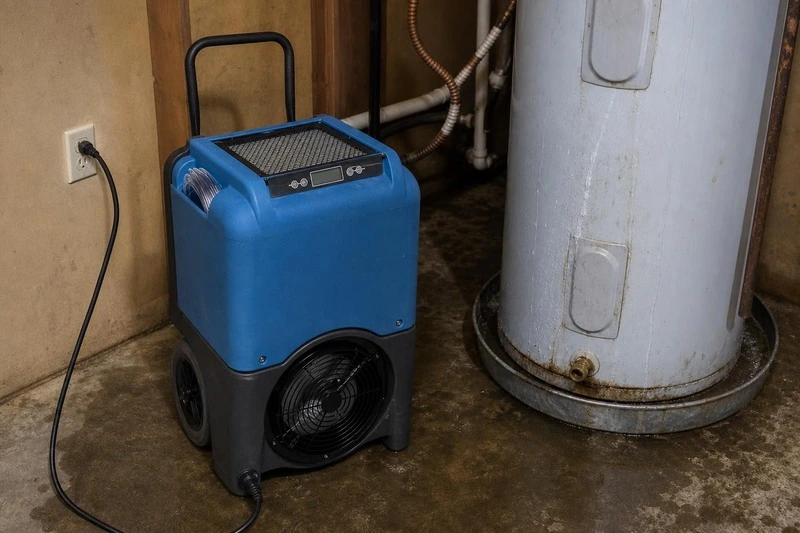
A desiccant unit goes in when a basement runs cold and a standard dehumidifier starts losing ground. Structural drying means the framing and the subfloor rather than the surface, and the equipment stays until the moisture content stops falling.
None of it rescues a glue line that has already opened. That is why we settle the floor question before we switch a machine on.
What Stays Down and What We Lift
Plenty of what leaves the house after a water loss did not have to go. Some of it was gone before we arrived, and pretending otherwise books a second visit.
Solid wood trim, framing, and the slab itself dry out and stay. Engineered plank is the coin toss, and the glue line settles it.
Drywall, insulation, and anything with a paper face wick water upward and hold it. Where the readings say water climbed, that material comes out, and where they say it did not, it stays.
Water category counts as much as volume. Clean supply water and a sewage backup are not the same loss, and soft material a backup touched is not salvageable.
What to do before we get there
None of this replaces the equipment. It buys the floor a better starting position.
- Close the main valve first, and only if you can reach it without wading.
- Stay off the wet plank in socks, because the seams swell and turn slick.
- Lift what you cannot replace off the floor, starting with the box of handwritten journals nobody scanned.
- Open the interior doors so air can move between rooms.
The Parts of North Salt Lake We Cover
The whole city sits inside one ZIP code, 84054, and we work all of it. Foxboro sits low at 4,228 feet, Eaglewood at 4,354, against a city figure of 4,247 feet.
Four flood zones are mapped inside the city limits, A, AE, AO and X, with a floodway inside the AE. Which one covers an address is worth checking on Utah's state floodplain mapping tool.
The federal flood insurance record for 84054 holds three claims in all, the first with a date of loss in 2001 and the last in 2012. That is a thin record for a city this size.
Most of what we do is the wider job of the water damage restoration we run valley-wide, and this city is one stop on the map of everywhere we drive.
If water is still moving through the house, we chase it down and pull it out the minute we are inside.
If somebody has already raised mold, we start with an independent inspection report written by someone other than us. No mold remediation begins before that report exists.
Cities next to North Salt Lake
The same job runs in the towns just north of us, on the same clock and the same equipment. Woods Cross and Bountiful share our line, with West Bountiful the next one out.
Tell us what the floor is made of and the hour the water started. We can plan most of the rest before we arrive.
What This Costs, What Backs Up, and What the Words Mean
Nobody can price that from a description, and we will not guess at one. Size and depth move the number, and so does the source, since drain water costs more material. The days the equipment runs move it too. Call (801) 903-2904 with the room and the hour the water started.
That schedule belongs to a drain trade, not to us. What we can tell you is what a backup costs inside the house, since water coming up a floor drain is contaminated from the first second. If your lowest fixture has backed up more than once, treat the next one as a matter of when.
People use both words for the same phone call, so ask what the invoice actually covers. Ours covers extraction, hauling out material that cannot dry, and running machines until the moisture content stops falling. Putting a room back to how it looked is separate work, and somebody else prices it.
One Number Reaches the Whole Crew
The line rings through to a person at 3 a.m. exactly as it does at noon. Call Water Damage Restoration Salt Lake City and you hear an honest arrival time, not a script.
Check the Glue Line Before You Decide
Standing water comes off the plank in overlapping passes from the low corner, and the hour it started tells us how much room that floor has left.