
Water Damage Restoration South Jordan, UT
Look at the seams before anything else, because panel subfloor swells there first and the swell draws the wet area for you. Describe that line to us on the phone and we decide what comes up.
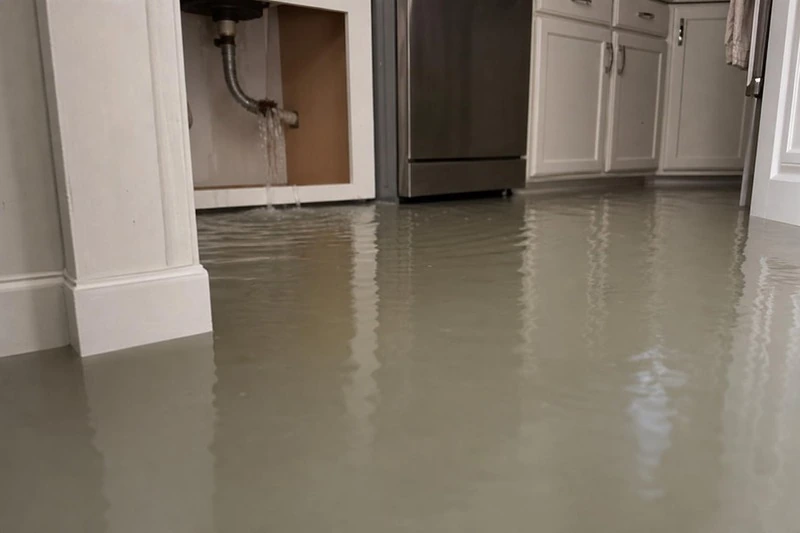
Pulling the Water Out of a South Jordan Floor, in Order
South Jordan stands mostly in detached houses on their own lots. A wide floor plan gives standing water room to travel before anyone sees the edge of it.
So the first job is removal. We take the standing water off the finish floor with a wet vac, then work the corners and thresholds with a shop vac.
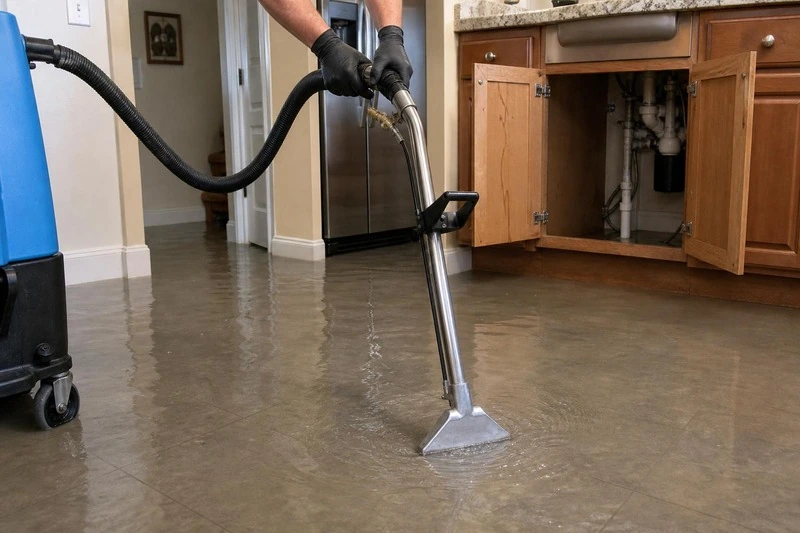
The water that sets the size of this job is not the water you can see. It is the water that got past the finish floor and reached the subfloor panels underneath.
Why we read the seams before we open anything
Panel subfloor swells at the seams first, so a seam shows the depth of the problem before the open field does. We read the seam line across the floor and let the swell pattern map how far the water traveled.
That map decides where the floor comes up. On carpet we lift it, take the pad out, and float the carpet on air movers, because nothing under either can be read while it is down.
The order that turns a small loss into a big one
The failure we get called in behind is almost always an order-of-work failure. Someone sets dehumidifiers in a closed room on day one, and the panels keep swelling under flooring nobody measured.
Material that is coming out anyway should come out before the gear runs. Otherwise the machines spend a day pulling water from a panel already headed for the dumpster.
Four decisions run in this order on a water call here, and flipping any two costs you money.
- We read the seam line first, and that reading draws the wet area, instead of a guess from the doorway.
- The carpet comes up and the pad goes out next, because a wet pad hides the panel it is lying on, every time.
- The floor opens at the panel joints, where the water pooled and keeps feeding the room, and the wet vac works there.
- The drying gear starts last, once the room it has to dry is a measured room, not an estimated one.
Every Way Water Gets Into a South Jordan Home
We do not sort these calls by what broke. What the water reached under the finish floor is what sizes the job.
Most of the housing here is young. Builders finished 9,327 homes between 2010 and 2019, out of 26,391 housing units in the city.
In homes like those the water usually starts at a fitting. An appliance supply line behind the washing machine or dishwasher lets go. A water heater splits at the bottom of the tank, or a toilet or fixture overflow runs for hours with nobody home.
Burst and frozen pipes sit in the same group, most often in a garage wall or an unheated crawl space. A finished basement adds two more: a sump pump failure during an outage, and a sewer or drain backup that comes up the floor drain.
Outside, large lots come with large irrigation. A sprinkler line or an irrigation backflow that fails beside the foundation sends water straight down the window well.
What the age of the house changes
Only 8.9 percent of South Jordan homes went up before 1980, and 1,522 of them date from the 1970s. That older tenth brings its own failure: a swamp cooler leak, where an evaporative cooler on the roof drains into the ceiling below.
Older ground work shows up too. Basement seepage and groundwater push in through a foundation after a wet stretch, and that water still has to come off the floor.
Weather does not care how old the house is. An ice dam is the one that surprises people, because the roof looks fine from the street. A plain roof leak does it more quietly. Snowmelt and storm runoff skip the roof and take the low door instead. South Jordan City runs a public storm water program for city drainage, and the same drainage decides where runoff on your lot ends up.
Drying the Structure Once the Floor Is Open
Drying starts after the water is out and the wet area is known. A room dries at the speed of its wettest layer, and on a panel floor that layer is the seam.
Where the swell ran to a wall, the baseboard comes off and stays off. We drill weep holes low in the drywall so the cavity behind it can dry. Air movers push across the open floor while dehumidifiers pull that water back out of the air.
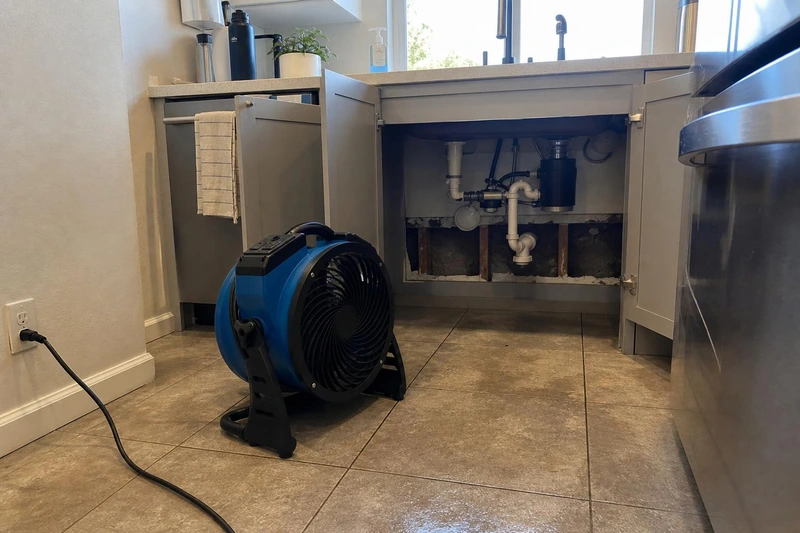
On a heavy soak we bring a desiccant dehumidifier instead. It keeps working in a cold basement where a standard unit slows down.
The gear stays until the panels stop giving water back. We check the same seams each day, because those seams already told us where the water went.
What Comes Out of the House and What Stays
Some materials dry and some never come back. A panel that swelled at the seams and stayed swollen is finished, and so is soaked insulation.
Contents are the part people get backwards. Lift what you could never replace off the floor before anything else moves, the box of yearbooks and team photos under the stairs.
Deciding what leaves the house
- Wet pad and soaked insulation leave the same day, because neither one dries in place, whatever the machines are set to.
- Swollen panel comes up to the line the swell drew, and it stops where the seam reading stops, not at the nearest wall.
- The finish floor gets its answer last, after we have read the subfloor under it, and that call is yours to make.
Where We Work Across South Jordan
Daybreak and Oquirrh Park sit about a mile apart on the west side, and we work both. Owners occupy 84.1 percent of the lived-in homes here. We walk the seam reading with you first, whoever is standing in the room.
The city holds both of its ZIP codes, 84009 and 84095, alone, which makes the flood record unusually clean. ZIP 84009 shows one claim, with a date of loss in 2015 and nothing paid on it. ZIP 84095 shows eight, running from 1978 through 2024, with $23,268.71 paid.
Those figures come from FEMA's national flood insurance claims dataset, and they only describe water that arrived from outside the building. The federal maps lay three designations over the city: Zone A, Zone AE including a floodway, and Zone X for the 0.2 percent annual chance band.
Water that is still arriving needs an extraction crew before anything else. If a floor sat wet for a week first, read what happens once mold is involved next.
We do this water damage restoration work across Salt Lake City, and we list every city we reach, West Jordan, Midvale and Herriman included.
Swollen Seams Never Flatten Out Again
Permanent means the material will not return to the shape it had before. Panel subfloor is the plainest example here, because a seam that swelled and stayed swollen never flattens out again.
Drywall and insulation behave the same way once they hold enough water. The seam reading tells us which parts of the room fall into that group.
Policies differ and only your carrier can answer it. Most treat the sudden water damage as one question and the failed line as a separate one, so ask about both before work starts.
Take pictures while everything is still where the water left it. A claim leans hard on what you can show once the floor is open.
Water under a slab has nowhere easy to go, so it moves sideways and surfaces at the edges of the room. A warm patch underfoot, or a meter that keeps turning with every tap shut, are the usual early signs.
Above a panel subfloor the signs land elsewhere. Water spreads along the joist bays, and the seams over those bays swell before anything on the surface changes.
One Number Reaches the Whole Crew
The line rings through to a person at 3 a.m. exactly as it does at noon. Call Water Damage Restoration Salt Lake City and you hear an honest arrival time, not a script.
Take the Seam Reading First
Nothing comes up until we read the seam line, because the order of work is what turns a small loss into a big one. How far across the floor does the swell run?